
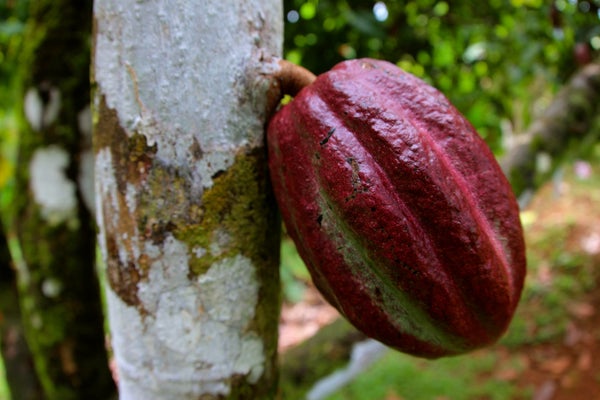
Fungi and viruses are poised to doom chocolate, which is why scientists are racing to save cacao—the tree that sprouts the colorful, football-size pods containing beans used to make chocolate—with the gene-editing tool known as CRISPR-Cas9, according to a new report.
Cacao trees (Theobroma cacao) grow in tropical environments, within about 20 degrees north and 20 degrees south of the equator. Unfortunately for chocolate lovers, fungi also flourish in tropical conditions and can easily infect entire cacao tree farms, causing harmful conditions such as frosty pod, black pod and witch's broom, according to a 2016 report from the National Oceanic and Atmospheric Administration.
"Cacao can be afflicted by several devastating conditions," Brian Staskawicz, a professor in the Department of Plant and Microbial Biology at the University of California, Berkeley, said in a statement on Jan. 2. "We're developing CRISPR editing technologies to alter the DNA in cacao plants to become more resistant to both viral and fungal diseases." [10 Amazing Things Scientists Just Did with CRISPR]
On supporting science journalism
If you're enjoying this article, consider supporting our award-winning journalism by subscribing. By purchasing a subscription you are helping to ensure the future of impactful stories about the discoveries and ideas shaping our world today.
Human-caused climate change is also putting the trees at risk, as rising temperatures caused by greenhouse-gas emissions may alter climatic conditions where cacao trees typically grow, mainly in West Africa and Indonesia. These warmer and drier conditions may cause chocolate shortages as early as 2050, according to the 2016 report.
Chocolate is more than a delicious treat. Cacao helps employ up to 50 million people worldwide, according to the World Cocoa Foundation. In an effort to save the tree and its crop, Mars Inc.—which makes M&M's, 3 Musketeers and Snickers—has teamed up with scientists at the Innovative Genomics Institute (IGI) to engineer trees that are resistant to certain fungi and viruses.
Their main tool is CRISPR-Cas9, a pair of molecular scissors that can precisely cut out chunks of DNA and replace them with new stretches of DNA. Myeong-Je Cho, director of plant genomics and transformation at IGI, is already working with cacao seedlings, looking for ways to help cacao growers stay put even as the climate warms and fungi invade their farms.
Any lessons learned during the cacao project could be applied to other crops.
"Similar strategies should be useful for protecting a variety of plants from infection, including important crops like cassava, rice and wheat," Staskawicz said.
CRISPR-Cas9 will likely help researchers find fungi- and virus-resistant trees sooner than cross pollinating plants the old-fashioned way. Cacao trees take between five and seven years to grow their colorful pods, and it isn't clear whether these pods will be susceptible to disease until they are grown. With CRISPR-Cas9, scientists can engineer the plants to be resistant from the get-go.
Editor's Recommendations
Copyright 2017 LiveScience.com, a Purch company. All rights reserved. This material may not be published, broadcast, rewritten or redistributed.
