
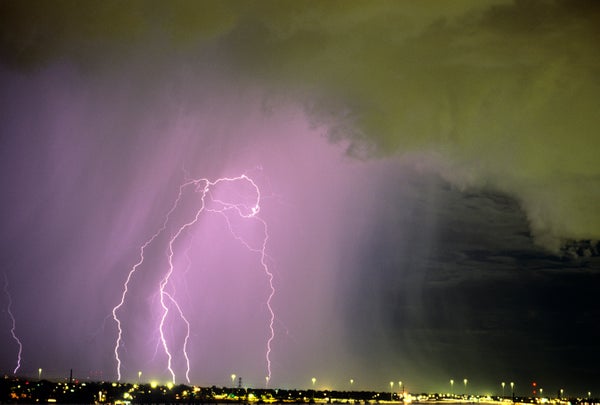
Severe thunderstorms aren’t just a risk to people on the ground. Scientists suspect intense storms also contribute to climate change, and a new NASA experiment aims to better understand that dynamic.
The effort—which is scheduled for this summer and next—looks to more closely examine a meteorological phenomenon known as “overshooting storms.” These severe storms feature a protrusion that rises above the main part of the storm. The intense thunderstorms are of interest to scientists for how they can affect the atmosphere.
“This is the first mission that is specifically designed to look at the impacts of overshooting storms,” said Kenneth Bowman, the project’s principal investigator, in a statement released by NASA.
On supporting science journalism
If you're enjoying this article, consider supporting our award-winning journalism by subscribing. By purchasing a subscription you are helping to ensure the future of impactful stories about the discoveries and ideas shaping our world today.
Most thunderstorms occur in the lowest layer of the atmosphere, known as the troposphere. But when there is an intense thunderstorm, air can rise from the storm and infiltrate the layer above, called stratosphere.
“When you have really strong storms, the updraft can be so intense that they actually carry water and particles and a variety of chemicals all the way up into the stratosphere layer, which is where most of the Earth's ozone is,” said Bowman, a professor of atmospheric science at Texas A&M University.
That’s worrisome because the air can carry water and pollutants that typically don’t reach the stratosphere. Their presence can have a significant impact on the stratosphere chemical composition.
“One of the things that we want to find out whether these storms actually have an effect on the ozone layer,” Bowman said.
In addition, the stratosphere is so dry that when water enters it, the water becomes a greenhouse gas that can contribute to global warming.
To find out more, scientists plan to send high-altitude ER-2 aircraft “as high as 70,000 feet to collect atmospheric chemistry samples to better understand material transported to the stratosphere by convective storms," according to a NASA summary of the experiment.
The ER-2 flights will be planned to intercept plumes from storms hours to days after they occur. Flights on consecutive days will allow for revising of the same plumes at different times to study how the chemicals within the plumes change in the stratosphere.
Flights will launch from Salina, Kan.—an ideal location because overshooting thunderstorms are common over the central United States, according to NASA.
“From this project, we'll have a really good picture of what's happening right now, so that we can better understand how things might change in the future,” Bowman said.
Reprinted from E&E News with permission from POLITICO, LLC. Copyright 2021. E&E News provides essential news for energy and environment professionals.