
By Lisa Rapaport
(Reuters Health) - Building exercise into lessons might help kids get better grades, especially when the task at hand requires memorization, a small Dutch study suggests.
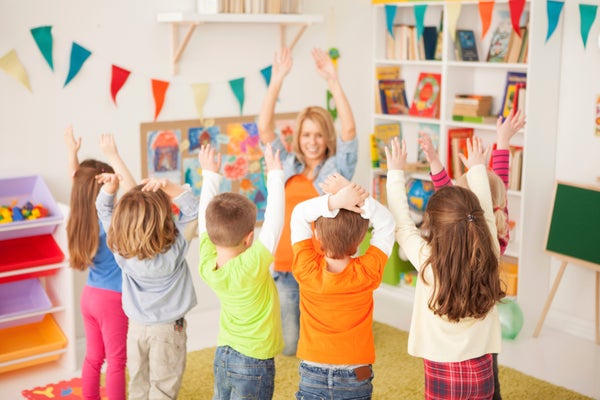
Researchers worked with 500 children in second and third grade, giving half of them traditional lessons while the rest got instruction supplemented with physical activity designed to reinforce math and language lessons.
On supporting science journalism
If you're enjoying this article, consider supporting our award-winning journalism by subscribing. By purchasing a subscription you are helping to ensure the future of impactful stories about the discoveries and ideas shaping our world today.
After two years, children who got the physically active lessons had significantly higher scores in math and spelling than their peers who didn't exercise during class.
"Previous research showed effects of recess and physical activity breaks," said lead study author Marijke Mullender-Wijnsma of the University of Gronigen in The Netherlands.
"However, we think that the integration of physical activity into academic lessons will result in bigger effects on academic achievement," Mullender-Wijnsma added by email.
To assess the potential for exercise to influence learning, Mullender-Wijnsma and colleagues developed a curriculum that matched typical lessons in academic subject matter but added physical activity as part of instruction. They tested it in 12 elementary schools.
Lessons involved constant practice and repetition reinforced by body movements. For example, children jumped in place eight times to solve the multiplication problem 2 x 4.
Children in the exercise group received 22 weeks of instruction three times a week during two school years. These lessons were up to 30 minutes long, and evenly split between math and spelling instruction.
In math tests focused on speed, there wasn't much difference in performance among the two groups of students after one year of physically active teaching.
But after two years, children who received exercise-based instruction had significantly higher scores on the math speed exams than students who didn't. The difference over two years equated to more than four months of additional learning for the students who had physically active lessons, researchers note in the journal Pediatrics, online February 24.
With another type of math test focused on lesson comprehension, students in the exercise group outperformed their peers in both the first and second year of the study. After two years, the exercise group achieved the equivalent of four months' extra learning.
For spelling, there wasn't much difference between the student groups after one year. But by the end of the second year they did have significantly better test scores, again, roughly amounting to four more months of learning.
Exercise didn't appear to impact reading, however. It's possible that physical activities may be more beneficial to learning that involves repetition, memorization and practice of lessons from previous classes, the researchers conclude.
The reading test required students to read as many words as possible in one minute - a skill that wasn't practiced in the lessons done as part of the experiment, the authors note. Instruction during the study focused on solving arithmetic problems and spelling words, tasks where students did improve more with exercise during lessons.
One limitation of the study is that some of the improved performance in the exercise group during the first year might be due to the specially trained teachers, the researchers point out. Individual schools administered tests, which might also have influenced the results.
The study team did not examine why activity during learning seemed to help. It may be, as many other studies have shown, that exercise in general benefits the brain. Or, exercise during learning might improve engagement, they write, since brain and body work together.
It's unclear how results from schools in The Netherlands might play out in other countries where students come from more diverse racial, ethnic and socioeconomic backgrounds, Sara Benjamin Neelon of Johns Hopkins University and colleagues write in an accompanying editorial.
The novelty of the physically active lessons for students used to sitting at desks, rather than just the exercise itself, also might have contributed to performance improvements, Benjamin Neelon said by email.
Some other interventions have focused on exercise breaks between lessons, and one question with physical activity during lessons is whether it might detract from achievement in some situations or for certain students, Benjamin Neelon added.
"However, the take-home message for parents and teachers is that physically active lessons may be a novel way to increase physical activity and improve academic performance - at the same time," Benjamin Neelon said.