
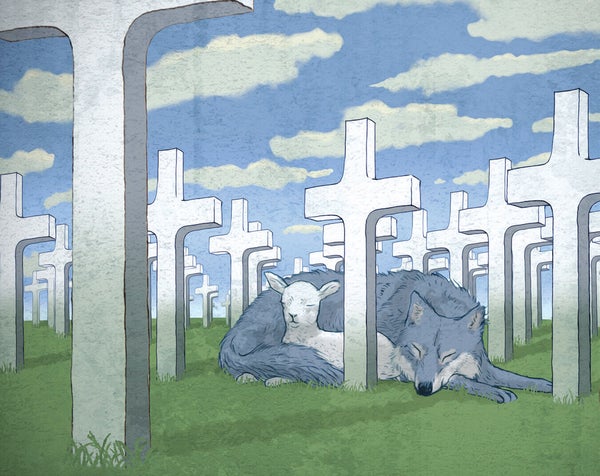
After binge-watching the 18-hour PBS documentary series The Vietnam War, by Ken Burns and Lynn Novick, I was left emotionally emptied and ethically exhausted from seeing politicians in the throes of deception, self-deception and the sunk-cost bias that resulted in a body count totaling more than three million dead North and South Vietnamese civilians and soldiers, along with more than 58,000 American troops. With historical perspective, it is now evident to all but delusional ideologues that the war was an utter waste of human lives, economic resources, political capital and moral reserves. By the end, I concluded that war should be outlawed.
In point of fact, war was outlawed ... in 1928. Say what?
In their history of how this happened, The Internationalists: How a Radical Plan to Outlaw War Remade the World (Simon & Schuster, 2017), Yale University legal scholars Oona A. Hathaway and Scott J. Shapiro begin with the contorted legal machinations of lawyers, legislators and politicians in the 17th century that made war, in the words of Prussian military theorist Carl von Clausewitz, “the continuation of politics by other means.” Those means included a license to kill other people, take their stuff and occupy their land. Legally. How?
On supporting science journalism
If you're enjoying this article, consider supporting our award-winning journalism by subscribing. By purchasing a subscription you are helping to ensure the future of impactful stories about the discoveries and ideas shaping our world today.
In 1625 the renowned Dutch jurist Hugo Grotius penned a hundreds-page-long treatise originating with an earlier, similarly long legal justification for his country's capture of the Portuguese merchant ship Santa Catarina when those two countries were in conflict over trading routes. In short, The Law of War and Peace argued that if individuals have rights that can be defended through courts, then nations have rights that can be defended through war because there was no world court.
As a consequence, nations have felt at liberty for four centuries to justify their bellicosity through “war manifestos,” legal statements outlining their “just causes” for “just wars.” Hathaway and Shapiro compiled more than 400 such documents into a database on which they conducted a content analysis. The most common rationalizations for war were self-defense (69 percent); enforcing treaty obligations (47 percent); compensation for tortious injuries (42 percent); violations of the laws of war or law of nations (35 percent); stopping those who would disrupt the balance of power (33 percent); and protection of trade interests (19 percent). These war manifestos are, in short, an exercise in motivated reasoning employing the confirmation bias, the hindsight bias and other cognitive heuristics to justify a predetermined end. Instead of “I came, I saw, I conquered,” these declarations read more like “I was just standing there minding my own business when he threatened me. I had to defend myself by attacking him.” The problem with this arrangement is obvious. Call it the moralization bias: the belief that our cause is moral and just and that anyone who disagrees is not just wrong but immoral.
In 1917, with the carnage of the First World War evident to all, a Chicago corporate lawyer named Salmon Levinson reasoned, “We should have, not as now, laws of war, but laws against war; just as there are no laws of murder or of poisoning, but laws against them.” With the championing of philosopher John Dewey and support of Foreign Minister Aristide Briand of France, Foreign Minister Gustav Stresemann of Germany and U.S. Secretary of State Frank B. Kellogg, Levinson's dream of war outlawry came to fruition with the General Pact for the Renunciation of War (otherwise known as the Peace Pact or the Kellogg-Briand Pact), signed in Paris in 1928. War was outlawed.
Given the number of wars since, what happened? The moralization bias was dialed up to 11, of course, but there was also a lack of enforcement. That began to change after the ruinous Second World War, when the concept of “outcasting” took hold, the most common example being economic sanctions. “Instead of doing something to the rule breakers, Hathaway and Shapiro explain, “outcasters refuse to do something with the rule breakers.” This principle of exclusion doesn't always work (Cuba, Russia), but sometimes it does (Turkey, Iran), and it is almost always better than war. The result, the researchers show, is that “interstate war has declined precipitously, and conquests have almost completely disappeared.”
Outcasting has yet to work with North Korea. But as tempting as a military response may be to some, given that country's geography we might heed the words from Pete Seeger's Vietnam War protest song: “We were waist deep in the Big Muddy/The big fool says to push on.” We know how that worked out.