
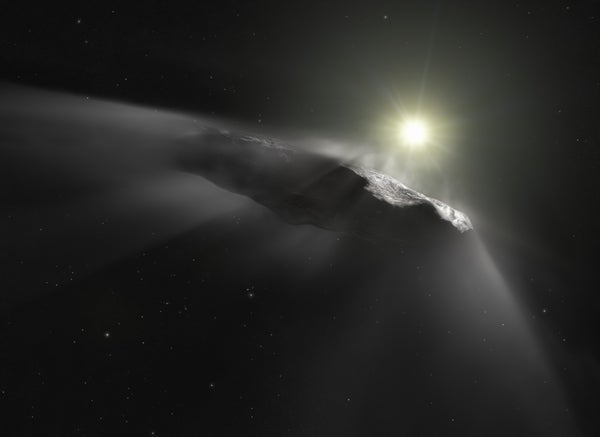
When an interstellar object called ‘Oumuamua raced through our solar system last year, astronomers were thrilled. The event provided the first glimpse, however fleeting, of a visitor from another star. But almost immediately a taxing question was raised: where did it come from?
A number of studies have since attempted to answer this question, pointing in the general direction of constellations like Lyra. But none is as accurate as the latest effort by Coryn Bailer-Jones from the Max Planck Institute for Astronomy and his colleagues, to be published in The Astronomical Journal. They did not just find the direction it was coming from; they suggested four stars that could have been ‘Oumuamua’s home. “Of all the studies that have been done on the origin, I think this is the most comprehensive,” Bailer-Jones says.
‘Oumuamua, which roughly translates as “a messenger from afar arriving first,” measures about 400 meters long. It is now beyond the orbit of Jupiter on its way out of our solar system, never to return. But our relatively short encounter provided quite a few details, including its probable shape (like a cigar) and that it was spinning rapidly. Astronomers also worked out its velocity and trajectory, and by tracing this back in time about 10 million years, Bailer-Jones and his team looked at which stars ‘Oumuamua’s path had passed near on its way to us. Presumably, if ‘Oumuamua’s path came close to intersecting with that of another star, that star might have been the birthplace of this mysterious interstellar interloper.
On supporting science journalism
If you're enjoying this article, consider supporting our award-winning journalism by subscribing. By purchasing a subscription you are helping to ensure the future of impactful stories about the discoveries and ideas shaping our world today.
Finding ‘Oumuamua’s home could tell us a lot not only about the object itself, including its maximum age, but also our own origins. Believed to be an asteroid, it may be a remnant of planetary formation in another system, giving us an insight into how worlds coalesce around other stars. “If we find [its home] is a star like the sun, then this tells us about objects which may have formed in the early solar system, and were subsequently removed,” says Eric Gaidos from the University of Hawaii at Manoa, who was not involved in this study. And if ‘Oumuamua was ejected from its home system by an unseen planet there, rather than by interactions between a pair of stars as some suspect, we could also perform follow-up studies to find that hidden world.
To find suitable stars that might be ‘Oumuamua’s long-lost home, Bailer-Jones and his colleagues used data from the European Space Agency’s Gaia spacecraft, which is currently mapping 1 percent of the stars in our galaxy. Three position coordinates and three velocity coordinates were needed to precisely track a star’s motion through space, including its radial motion towards or away from us. And in its second and latest data release of 1.3 billion stars in April 2018, Gaia revealed all six coordinates for about seven million stars. “None of this would have been possible without the new Gaia data,” says co-author Sukanya Chakrabarti from the Rochester Institute of Technology in upstate New York. The study’s authors were able to add an extra 200,000 stars containing radial velocity data from the SIMBAD astronomical database.
From these 7.2 million stars, the team looked for encounters where ‘Oumuamua passed close—less than six light-years—and at a velocity of less than 30 kilometers per second, suggesting it may have originated there and was not instead just passing by. This analysis yielded four candidates from the initial batch, all dwarf stars. ‘Oumuamua came closest to a star called HIP 3757 at a distance of about 1.96 light-years, but at a relatively high velocity of 25 km/sec. It passed a second, HD 292249, at a distance of five light-years but at just 11 km/sec. And it passed closely at fairly low velocities to two others that have not yet been named, dubbed “home-3” and “home-4.”
While each of the stars is promising, none of them is an ideal candidate for ‘Oumuamua’s home—something the authors readily admit. Even so, from the available data, these are undoubtedly the best candidates. But none can truly be classed as ‘Oumuamua’s star, as it either passes them too quickly or too distantly, with additional large uncertainties in their velocity or position relative to ‘Oumuamua. “These could be characterized as the ‘least worst’ [potential home stars],” says Gaidos.
The main problem is that we simply do not have enough information yet, notes Alan Fitzsimmons from Queen's University Belfast, who was not involved in the study. While Gaia’s data are extensive, they cover a fraction of the total number of stars ‘Oumuamua could have come from. What is more, without knowing its age, the object could feasibly have come from much further afield—almost anywhere in the galaxy. And even then, finding its star may be an impossible task owing to the accumulated gravitational nudges with other stars that have altered and masked its original path.
Even with the next batch of Gaia data slated to be released in 2021, pinpointing ‘Oumuamua’s home will be difficult. But there is always a chance. “I suspect we may never identify the home system for the object,” says Fitzsimmons. “I’d love to be wrong though.”
Jonathan O'Callaghan is a freelance space and science journalist based in London.