
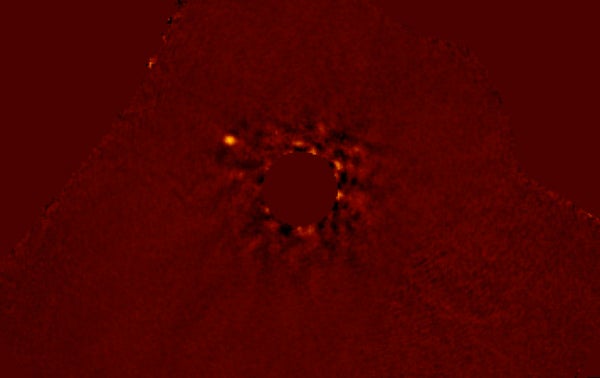
Astronomers using the Subaru Telescope in Hawaii recently discovered (pdf) a "super-Jupiter" orbiting the star Kappa Andromedae (κ Andromedae) a star about 2.5 times the mass of our sun located about 170 light-years from Earth.
κ Andromedae is a young star, only 30 million years old, compared with our sun's age of five billion years. Its companion planet, κ Andromedae b, is about 12.8 times Jupiter's mass and orbits at about 1.8 times the distance between Neptune and our sun. Astronomers are not entirely sure whether it is a huge planet or a low-mass brown dwarf, an entity in between planet and star.
Joe Carson, an astrophysicist at the College of Charleston and the Max Planck Institute for Astronomy and lead author of the paper describing the discovery, says that the most exciting part of the discovery is that κ Andromedae "is by far the most massive star where we see evidence of normal planet formation—the kind that went on in our solar system."
On supporting science journalism
If you're enjoying this article, consider supporting our award-winning journalism by subscribing. By purchasing a subscription you are helping to ensure the future of impactful stories about the discoveries and ideas shaping our world today.
κ Andromedae b is also one of the few exoplanets astronomers have seen directly. Although exo-worlds are plentiful, they can be difficult to see because stars are about a billion times brighter than planets. "There's this teeny signal from the planet—it's completely overwhelmed by the star," Carson says. For that reason, most planets are discovered by indirect means, such as when a planet passes in front of its host star and blocks some of its light.
Carson says that to directly photograph κ Andromedae b the team had to filter out as much of the star's light as possible. "In astronomy we can subtract two images from each other the same way in mathematics we subtract two numbers," he says. But simply subtracting one image from another would also subtract out any light from a hidden planet. So the astronomers took multiple "snapshots" of the region of the sky containing the κ Andromedae system, rotating the telescope between shots. Because the star's light is basically symmetric, subtracting the light of the rotated images canceled out the light of the star, which remained at the center of the images, leaving the light of the planet, which moves around as the telescope is rotated.
The image above was created by coloring an infrared image of the system. The star is artificially eclipsed by a disc in the middle. The planet is the bright yellow dot in the upper left, and the speckled pattern around the disc is residual light from the image-subtraction process.
Carson says that this discovery opens the door for many follow-up studies. Further studies using different wavelengths of light will tell astronomers more about the planet's atmosphere, which will help them determine its mass, temperature, weather—and even discern if the planet might have Saturn-like rings. More broadly, "when you have one planet around a star, there's a good chance there's one or more other planets around the star," Carson says. Because astronomers didn't even know that such a massive star could support normal planetary formation, the study of all the planets in the system could prove especially fruitful. "It's like opening a treasure chest of new discoveries," he adds.
—Evelyn Lamb