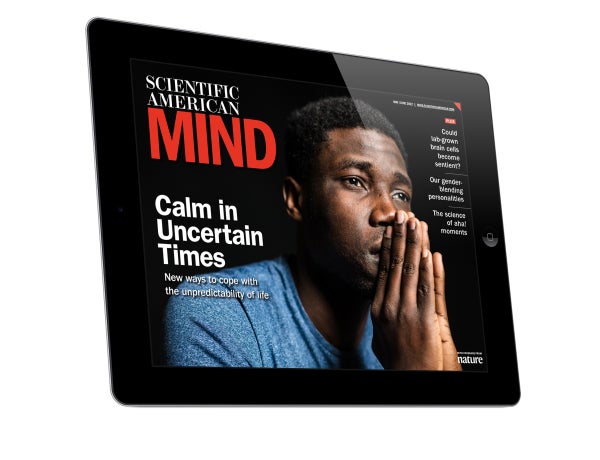
I wish I could write that a global pandemic was our only problem at the moment. While the U.S. approaches the sad milestone of one million citizens dead from COVID-19, a devastating land war in Europe is displacing millions, and a rapidly warming planet has caused another Antarctic glacier collapse. Bad news seems to dominate headlines and Twitter feeds. As reporter Francine Russo writes in this issue, the uncertainty of our times has hit some individuals particularly hard (see “The Personality Trait ‘Intolerance of Uncertainty’ Causes Anguish during COVID”).
Even as COVID cases ease in many U.S. states, some people are at risk of withdrawing further into isolation rather than rejoining social events and interactions, as medical experts Carol W. Berman and Xi Chen explain (see “COVID Threatens to Bring a Wave of Hikikomori to America”). But small pleasurable routines can work wonders in an unpredictable world; a mere two hours a week in nature has been shown to improve psychological well-being. As we continue to grapple with whatever news comes our way, we are already doing precisely what is required: we must continue.
Subscribe to Support Independent Journalism
Great science journalism requires human expertise, time, effort and creativity. And it costs money. That’s why I and the journalists here at Scientific American hope you’ll join our community.
When you subscribe, you are supporting staff and freelance journalists who are passionate about telling science stories that are true, important and compelling. Our editors and reporters are often experts in their fields, which means they understand the nuances of big discoveries and can untangle the breakthroughs from the hype. With a subscription, you are also supporting rigorous fact-checking to ensure the words we publish are precise and accurate. And you’re supporting original illustrations, graphics and photos that bring you closer to an advanced laboratory, an ice sheet in Antarctica or a space mission in orbit. You’re helping us craft other types of high-quality journalism as well: Our newsletters are carefully written, edited and curated by staffers you have or will come to know and love. Our Science Quickly podcast is based on original reporting, collaboration with editors and scientists and exacting production.
Subscriptions keep this engine running so we can continue to deliver thoughtful, rigorous and independent science journalism to you. In an era of viral misinformation, this work is crucial. If you value what we do, I hope you’ll consider joining us as a subscriber
Thank you,
Jeanna Bryner, Editor in Chief, Scientific American