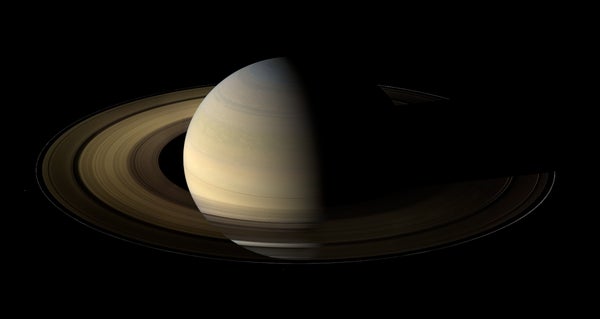
Cassini spacecraft panorama of Saturn at equinox yields unique view of rings
The Cassini spacecraft snapped this panorama of Saturn— actually a mosaic of dozens of photographs taken over eight hours —just after the ringed planet's equinox, which occurs once every 15 Earth years or so.
NASA/JPL/Space Science Institute
Join Our Community of Science Lovers!
On supporting science journalism
If you're enjoying this article, consider supporting our award-winning journalism by subscribing. By purchasing a subscription you are helping to ensure the future of impactful stories about the discoveries and ideas shaping our world today.
The Cassini spacecraft snapped this panorama of Saturn—actually a mosaic of dozens of photographs taken over eight hours—just after the ringed planet's equinox, which occurs once every 15 Earth years or so. During equinox, which fell in August, the plane of Saturn's rings align with the sun, making them nearly invisible from Earth but allowing nearby spacecraft a unique view of the rings' structure. (In this image, the illumination of the rings originates mostly from sunlight reflecting off of the planet.)
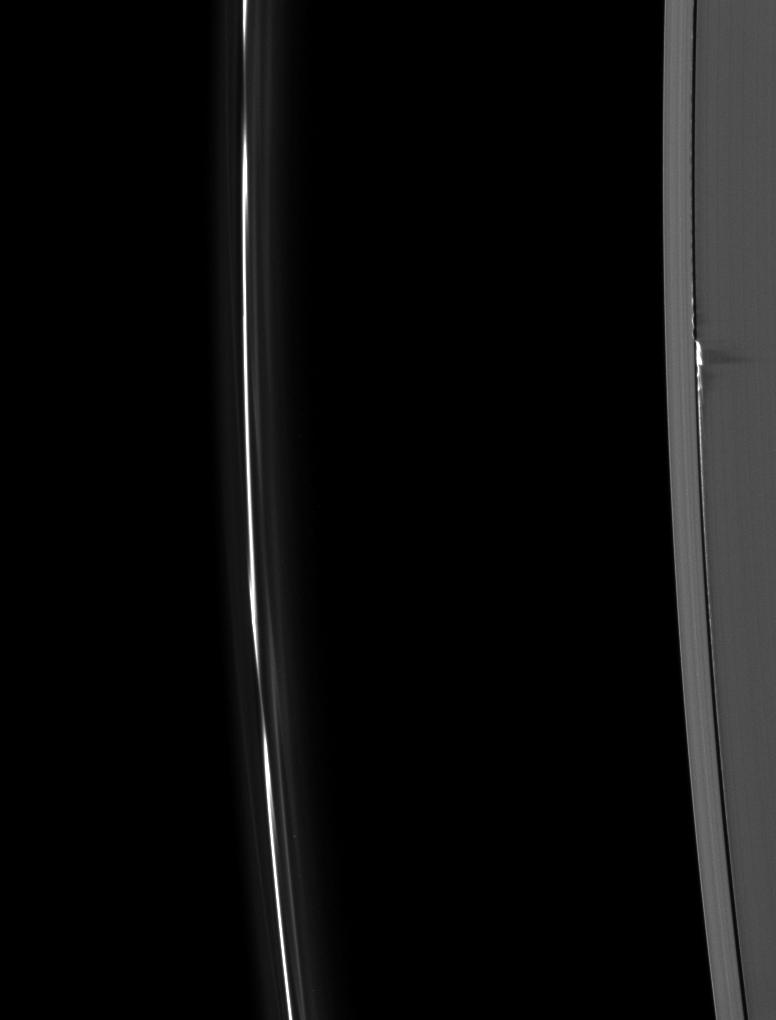
Among the discoveries from Cassini's unprecedented view: a four-kilometer-high wave in one of the planet's rings (viewable here in a photograph taken before equinox), apparently caused by the unusually close proximity of the ring's edge to Saturn's moon Daphnis. Thanks to the sun's low position relative to the rings, the peak cast a shadow roughly 500 kilometers long across the ring—on Earth, that shadow would darken the entire region between Boston and Philadelphia.
It’s Time to Stand Up for Science
If you enjoyed this article, I’d like to ask for your support. Scientific American has served as an advocate for science and industry for 180 years, and right now may be the most critical moment in that two-century history.
SciAm always educates and delights me, and inspires a sense of awe for our vast, beautiful universe. I hope it does that for you, too.
If you subscribe to Scientific American, you help ensure that our coverage is centered on meaningful research and discovery; that we have the resources to report on the decisions that threaten labs across the U.S.; and that we support both budding and working scientists at a time when the value of science itself too often goes unrecognized.