
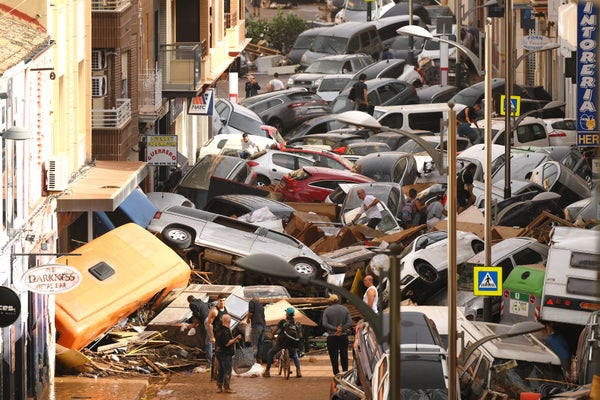
CLIMATEWIRE | Flash floods in southeastern Spain have killed at least 95 people and left dozens missing, officials said Thursday morning.
The country has been lashed by torrential rain this week. The worst-hit region is the province of Valencia, where floods and landslides have swept away cars, roads and buildings.
“The process of recovering and identifying the victims is beginning,” local authorities said Wednesday.
On supporting science journalism
If you're enjoying this article, consider supporting our award-winning journalism by subscribing. By purchasing a subscription you are helping to ensure the future of impactful stories about the discoveries and ideas shaping our world today.
Spanish Prime Minister Pedro Sánchez offered his condolences and support during a speech Wednesday morning.
“On behalf of the government of Spain and the whole of Spanish society, I would like to express all our solidarity and affection to the families of those who have died in this tragedy in the Valencian Community and Castilla la Mancha and to those who are still searching for their loved ones,” said Sánchez.
“We are going to help you with all the resources of the State. If necessary, the European Union,” he added.
European Commission President Ursula von der Leyen said the floods represented the "reality" of climate change.
“In just a few months, floods have hit Central and Eastern Europe, Italy and now Spain," von der Leyen said Wednesday. "This is the dramatic reality of climate change, and we must prepare to deal with it all across our Union and with all tools at our disposal.”
The floods have caused widespread disruption to rail and air travel across the south and east of the country. A high-speed train with about 300 people on board derailed near Malaga on Tuesday but rail authorities said there were no fatalities.
“We are facing an unprecedented situation,” Carlos Mazón, head of Valencia’s regional government, told reporters Wednesday.
The disaster in Spain comes after devastating floods in central Europe last month killed at least two dozen people. The likelihood of such floods has been greatly increased by global warming, climatologists have warned.
Further study of the specific storm would be needed to establish the amount of influence global warming had on the torrential rain, said Ernesto Rodríguez Camino, senior state meteorologist and member of Spanish Meteorological Association.
“We can’t say anything on the fly, except that in the context of climate change, these types of events will be more frequent and more intense,” he said.
Camino said warning systems for such extreme weather measured only precipitation. But he said the resulting death and destruction relied on all sorts of other factors, including the local geography, flood defenses, obstacles to the water and upstream rainfall.
“Between heavy rainfall and its destructive power, there is a whole chain of actions that must also be considered,” he said.
Reprinted from E&E News with permission from POLITICO, LLC. Copyright 2024. E&E News provides essential news for energy and environment professionals.