On supporting science journalism
If you're enjoying this article, consider supporting our award-winning journalism by subscribing. By purchasing a subscription you are helping to ensure the future of impactful stories about the discoveries and ideas shaping our world today.
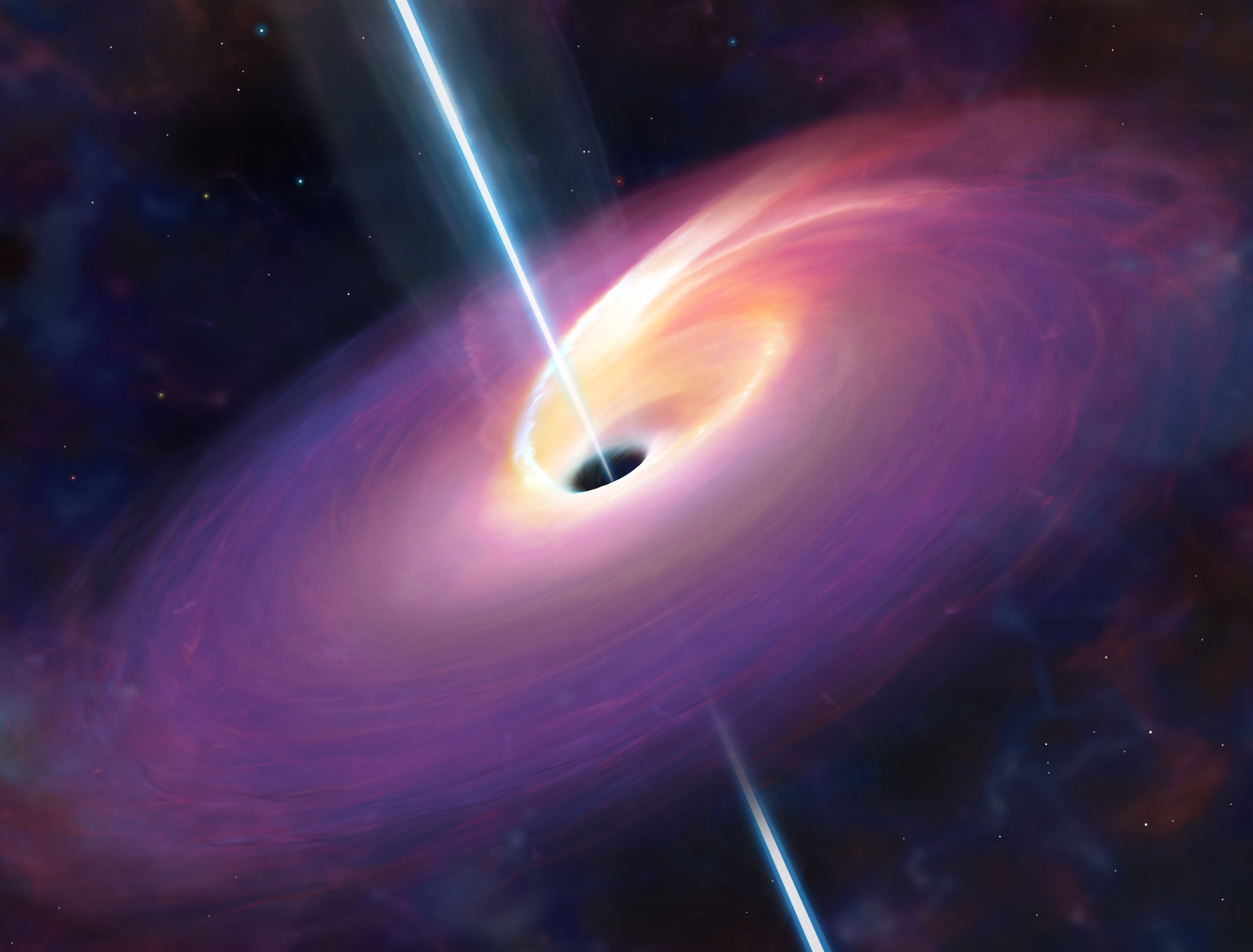
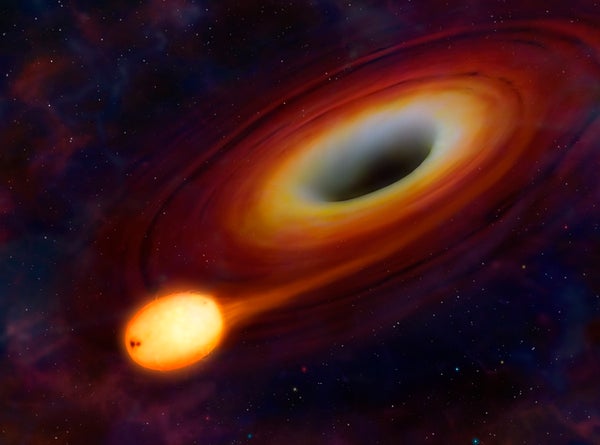
A black hole 3.8 billion light-years from Earth is shown in this artist's representation tearing apart a star that drifted within its gravitational pull. This scenario is part of a new explanation for one of the brightest events ever recorded by astronomers. After consuming the star the black hole released a high-energy beam of gamma rays and x-rays, according to Joshua Bloom of the University of California, Berkeley, and his associates. The research, based on data collected by NASA's orbiting Swift Gamma-Ray Burst observatory, is published in the June 16 issue of Science. In the same issue, Andrew Levan of the University of Warwick and his colleagues pinpoint the beam's source as a black hole at the center of a distant galaxy.
The signal that the Swift satellite received lasted longer than any previously detected gamma ray burst. Rather than declining in intensity after a few minutes as is typical, the brightness of the gamma rays continued to fluctuate and spike over the course of two days. Meanwhile, the x-ray flare's afterglow remained bright for more than two weeks.
The beam's longevity and intensity suggest that a massive black hole, more than a million times heavier than the sun, released two concentrated jets of energy after pulling a star apart. One of the beams pointed directly toward Earth whereas the other traveled off in the opposite direction. The beam's intensity fluctuated as the black hole sucked in leftover pieces of the doomed star.
—Sophie Bushwick