
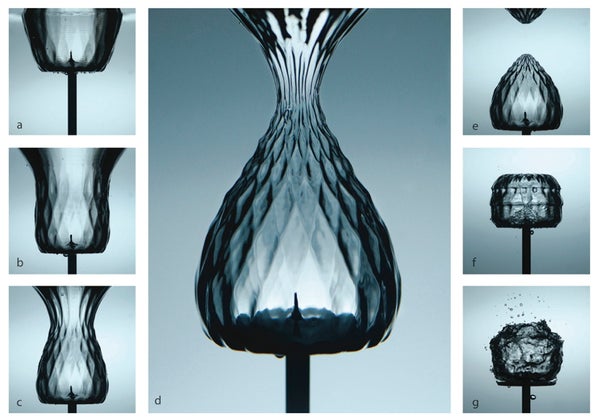
When a rock, an Olympic diver or any other object hits the water, an air cavity forms behind it. Fluid dynamicists study the shapes of these cavities and how they change and close over time. When a disk with 20 petals was pulled through a tank of water, it created the cavity shown in this striking set of images.
The disk moved at a constant speed of one meter per second. The air cavity pinched off just 200 milliseconds after the disk entered the water, a little before picture (e) in the diagram. In order to study cavities created this way, researchers record video at 10,000 frames per second and analyze it frame by frame.
Oscar Enriquez of the Physics of Fluids group at the University of Twente in the Netherlands studied the pineapple-shaped cavity for his master's thesis project. He and his collaborators, Ivo Peters, Stephan Gekle, Laura Schmidt, Devaraj van der Meer and Detlef Lohse then entered these images into the Gallery of Fluid Motion competition in 2010.
On supporting science journalism
If you're enjoying this article, consider supporting our award-winning journalism by subscribing. By purchasing a subscription you are helping to ensure the future of impactful stories about the discoveries and ideas shaping our world today.
The American Physical Society sponsors the competition at the annual fluid dynamics meeting every November. Participants submit posters and videos, which are judged based on scientific content, originality and aesthetic appeal. Twelve winning entries are published in the September issue of Physics of Fluids the following year. The Physics of Fluids group from Twente has won nine times. The pineapple earned them a Milton Van Dyke Award, given to the top three projects in each category: poster and video.
What is the secret of the group's success? "It's just luck," Enriquez says. "Sometimes upon doing experiments, you come across beautiful things." Fluid dynamics exhibits a variety of phenomena that lend themselves to appealing visuals: bubbles, impacts, viscous fluids and so on. "The field is very rich, and there are people who dedicate their careers to visualization of fluid phenomena," adds Enriquez, also a musician, who enjoys the opportunity to combine art and science.
—Evelyn Lamb