
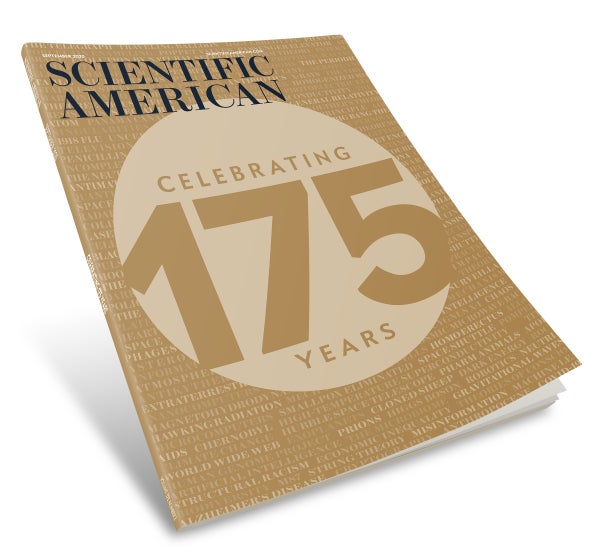
Welcome to Scientific American's 175th anniversary issue! We've had a blast putting it together and hope you enjoy it. Scientific American is the oldest continuously published magazine in the U.S. For our demisemiseptcentennial (also known as, no kidding, a quartoseptcentennial), we are presenting a mix of surprising history stories (featuring Harry Houdini, M. C. Escher and federal censors burning copies of our magazine) and deeper looks at some of the most transformative, thrilling, dizzying discoveries of the past 175 years.
When the magazine began, the universe didn't seem as big as it is today. Astronomers thought our Milky Way galaxy was the extent of the universe. Now we know we inhabit just one of over 100 billion galaxies. The universe isn't just mind-bendingly big, it's getting bigger, and—as if that weren't enough—the rate of expansion is faster all the time. Astrophysicist Martin Rees shows what we've learned and what the biggest questions are for the next 175 years.
One of the most disturbing discoveries of the past 175 years is that, on at least five occasions, most of the species on Earth have abruptly died off. The mass extinctions were triggered by massive volcanic activity or an asteroid impact, causing a cascade of catastrophe that disrupted the atmosphere and wiped out plants and animals that had ruled the planet for hundreds of millions of years. Now we are in danger of causing a sixth mass extinction. Author Peter Brannen guides us through the absolute worst times on Earth and shows what was lost.
On supporting science journalism
If you're enjoying this article, consider supporting our award-winning journalism by subscribing. By purchasing a subscription you are helping to ensure the future of impactful stories about the discoveries and ideas shaping our world today.
Charles Darwin published On the Origin of Species 14 years after Scientific American was established, transforming our understanding of life on Earth and of our own history as a species. Senior editor Kate Wong introduces our evolutionary ancestors from the past seven million years and reveals that our family tree is impressively tangled.
In the midst of a global pandemic, it's startling to read about how confident we once were that medicine could conquer infectious disease, as journalist Maryn McKenna recounts. Our best long-term hope for conquering the new coronavirus is research into vaccines and antivirals, but in the meantime, public health measures that have been used for more than 175 years are the best way to stay safe. That, and staying informed by trustworthy sources of scientific information.
The most visible differences between life in 1845 and 2020 are technological. Historians Naomi Oreskes and Erik M. Conway explore how science and technology have developed in parallel, each boosting the other, and how advances in information sharing are some of the main drivers of innovation.
To understand the information Scientific American has presented over the years, senior graphics editor Jen Christiansen and data designer Moritz Stefaner visualized the most commonly used words for each year of our existence. The visualization project begins here and continues throughout the issue with a time line and pairs of words that peaked in different years, showing ways the language of science has evolved.
The most shameful episodes in our history are when we used scientific language to promote bigotry. Senior editor Jen Schwartz and senior copy editor Dan Schlenoff reckon with the sexism and racism in our archives and show how science can be twisted to make bias seem like objectivity. We are committed to making Scientific American's future more inclusive and just.
Join us online at ScientificAmerican.com for more anniversary highlights, including an interactive featuring some of the greatest hits of science history. Search our database of most often used words to find your own patterns. Science has shaped our rich past, and we look forward to covering how it shapes the future.”