
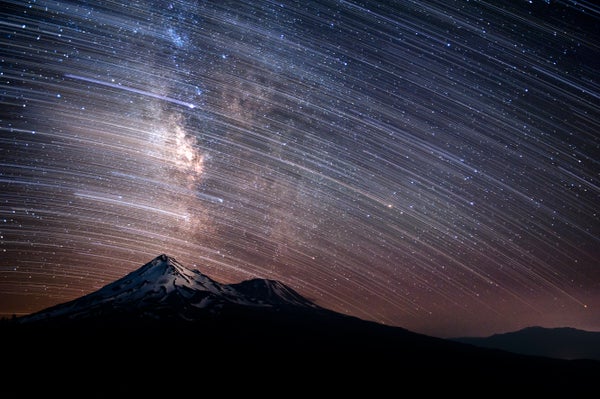
The sky is always changing. The planets move overhead as they trace their paths around the sun, and the moon rotates through the heavens as it circles our own world. Though the stars that provide their backdrop stay fixed in relation to one another, they too spin above as Earth makes its daily revolution and its yearly passage around the sun. To appreciate this ever-changing view, grab these sky maps, go outside at night, and look up!
August—September 2018: Visibility of Planets
During August and September, four bright planets can be seen in the evening sky, nearly equally spaced in a row marking the ecliptic, the line of the Sun's path in the sky. Venus is setting first in the west, followed by Jupiter, Saturn and Mars.
On supporting science journalism
If you're enjoying this article, consider supporting our award-winning journalism by subscribing. By purchasing a subscription you are helping to ensure the future of impactful stories about the discoveries and ideas shaping our world today.
August | Event |
|---|---|
4 | Moon: last quarter |
7 | Uranus stationary |
8 | Moon reaches northernmost declination (+20,4) |
9 | Mercury is in inferior conjunction Before Sunrise: old moon (waning crescent) visible low in the east |
10 | Moon is at perigee (358,078 km), apparent diameter 33 25 Moon: new moon (partial eclipse of the Sun visible in northernmost Canada, Greenland, Iceland, Scandinavia, most of Russia, Kazakhstan, Mongolia and most of China) Maximum of Perseid meteor shower |
13 | After sunset: young moon (waxing crescent) visible low in the west |
14 | After sunset: moon 5 north of Venus in constellation Virgo |
17 | Venus: greatest elongation east (45,9) Evening Sky: moon near Jupiter in constellation Libra |
18 | Moon: first quarter Mercury stationary |
20 | Evening sky: moon near Saturn in constellation Sagittarius |
22 | Moon reaches southernmost declination (–21,2), near Mars in constellation Sagittarius |
23 | Moon is at apogee (405.746 km) |
24 | Mercury: morning visibility begins |
26 | Moon: full moon |
28 | Mars stationary |
Mercury is in inferior conjunction on August 9 and is then heading away from the sun westward. The planet achieves its greatest western elongation on August 26. It can be spotted low on the eastern horizon shortly before sunrise between August 24 and September 10. On September 21, Mercury is in superior conjunction.
Venus can still be seen as the “evening star” in the west shortly after sunset. As the planet moves eastward through the constellation Virgo, its eastern elongation (the angular separation between the Sun and the planet) reaches 45.9 on August 17. Its visibility at dusk decreases, however, because the planet’s altitude drops from day to day until it fades away at the beginning of October.
Mars in the constellation Capricornus becomes visible at dusk, when it is well above the southeast horizon. The red planet can be viewed best in the hours around midnight when it is near the south meridian. Mars does not move much among the stars, its slow retrograde movement comes to a standstill on August 28 at the boundary between Capricornus and Sagittarius, and then it starts moving eastward again, as it will do for the next two years until the beginning of its next opposition period.

Credit: Brad Goldpaint Getty Images
September | Event |
|---|---|
3 | Moon: last quarter |
5 | Moon reaches northernmost declination (+20,4) |
6 | Saturn stationary |
7 | Neptune in opposition |
8 | Moon at perigee (361,350 km), apparent diameter 32 54 |
9 | Moon: new moon |
13 | Evening sky: moon near Jupiter |
16 | Moon: first quarter |
17 | Evening sky: moon near Saturn |
18 | Moon reaches southernmost |
19 | Evening sky: moon near Mars |
20 | Moon at apogee (404,880 km), apparent diameter 29 43 |
21 | Mercury in superior conjunction Venus: greatest illuminated extent |
23 | Equinox |
25 | Moon: full moon |
30 | Moon near Aldebaran in constellation Taurus |
Jupiter is visible in the evening sky in early August for about three hours until it sets in the west. The gas planet, famous for the four Galilean moons which show up clearly in binoculars and its Great RedSpot which can be seen through telescopes, shines in the southwest at dusk. The planet moves slowly eastward in the constellation Libra and in mid-August we will see it just north of the star Zubenelgenubi (a2 Lib). During September the planet’s visibility decreases as the Sun comes nearer from the west. But at the end of the month Jupiter and Venus make up a bright duo low in the southwest shortly after sunset.
Saturn is the fourth bright planet you can see in the evening sky. It stands in the western part of the constellation Sagittarius. By the time it is getting dark, Saturn reaches its highest altitude in the south.

Credit: Brad Goldpaint Getty Images