
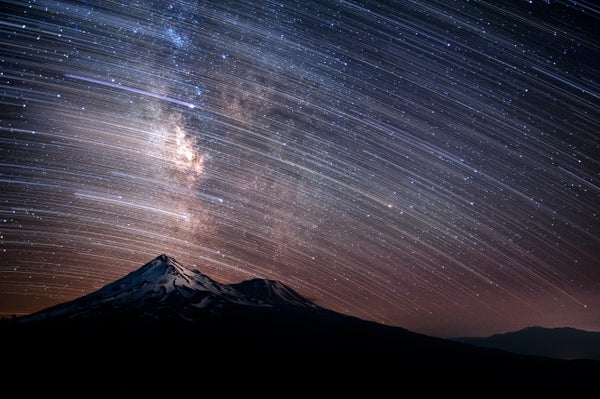
The sky is always changing. The planets move overhead as they trace their paths around the sun, and the moon rotates through the heavens as it circles our own world. Though the stars that provide their backdrop stay fixed in relation to one another, they too spin above as Earth makes its daily revolution and its yearly passage around the sun. To appreciate this ever-changing view, grab these sky maps, go outside at night, and look up!
December 2018 – January 2019: Visibility of the Planets
The end of the year and start of 2019 offer several special opportunities for planetary viewing. If you have never seen Mercury before, you can observe this elusive planet during December above the eastern horizon in the morning. In the coming weeks, spot Venus and the giant planet Jupiter. An exciting highlight in the New Year: a total lunar eclipse on January 21, 2019.
On supporting science journalism
If you're enjoying this article, consider supporting our award-winning journalism by subscribing. By purchasing a subscription you are helping to ensure the future of impactful stories about the discoveries and ideas shaping our world today.
December | Event |
|---|---|
2 | Venus: maximum brightness (–4.9 mag) |
3 | Morning sky: moon near Venus |
5 | Mercury: morning visibility begins Before sunrise: old moon (waning crescent) visible low in the east-southeast |
7 | Moon: new moon Minor planet (433) Eros (9.7 mag) in opposition |
9 | Moon reaches southernmost declination (–21.54°) Evening Sky: moon near Saturn |
12 | Moon at apogee (405,177 km), apparent diameter 29´ 32 |
14 | Maximum of Geminid meteor shower |
15 | Moon: first quarter Mercury in greatest elongation west (21.3°) |
20 | Evening Sky: moon near Aldebaran in constellation Taurus |
21 | Winter solstice |
22 | Moon: full moon Maximum of Ursid Meteor shower |
23 | Moon reaches northernmost declination (+21.55°) |
24 | Moon at perigee (361,061 km), apparent diameter 32´ 35 |
28 | Mercury: morning visibility ends |
29 | Moon: last quarter |
Mercury can be seen in December low above the southeastern horizon for nearly three weeks. After reaching its maximum separation from the sun in mid-December the distance begins to shrink rapidly. On December 22 Mercury passes Jupiter–an interesting binocular sight. By the end of the month, the innermost planet vanishes in the glare of the sun. In January 2019, Mercury is unobservable.
Venus becomes a dazzling sight high above the southeastern horizon. The planet reaches its greatest angular separation from the sun (greatest elongation) on January 6. Don’t miss the encounter of the “morning star” with the giant planet Jupiter on January 22 as well as the gathering of Venus, Jupiter and the crescent moon on January 30.

January | Event |
|---|---|
1 | Morning sky: moon near Venus in constellation Libra |
2 | Saturn in conjunction with sun |
3 | Earth at perihelion (147,100,000 km) Morning sky: moon near Jupiter in constellation Ophiuchus Maximum of Quadrantid meteor shower |
5 | New moon (partial solar eclipse visible in northeast Asia and the northern Pacific) Moon reaches southernmost declination (–21.6°) |
6 | Venus: greatest elongation west (46.9°) |
8 | Moon at apogee, 406,116 km, 29.4’ |
14 | Moon: first quarter |
17 | Moon near Aldebaran in constellation Taurus |
19 | Moon reaches northernmost declination (+21,54°) |
21 | Full moon Moon at perigee, 357,345 km, 33.4’ Total lunar eclipse visible in North and South America, Europe, the central Pacific, and Africa |
22 | Morning sky: Venus near Jupiter in constellation Ophiuchus Morning Sky: moon near Regulus in constellation Leo |
27 | Moon: last quarter |
30 | Mercury in superior conjunction Morning sky: moon near Jupiter and Venus in constellation Ophiuchus |
Mars can still be seen in the evening sky after sunset. During December and January the red planet moves from the constellation of Aquarius to Pisces while its apparent brightness decreases from 0.0 mag to +0.9 mag.
Jupiter, the largest and most massive planet of the solar system, becomes more conspicuous in the morning sky. After December 15, you can easily spot the giant low above the eastern horizon. On December 22, Jupiter will have a visitor: Mercury approaches, and the movement of both planets can be observed during the days before and after closest encounter.
Saturn is about halfway between Jupiter and Mars in the evening sky in the constellation Sagittarius, close to the Milky Way’s center. If you want to observe Saturn’s famous rings in a telescope, now is the time—for the remainder of the year Saturn will move too close to the sun for observation.
