
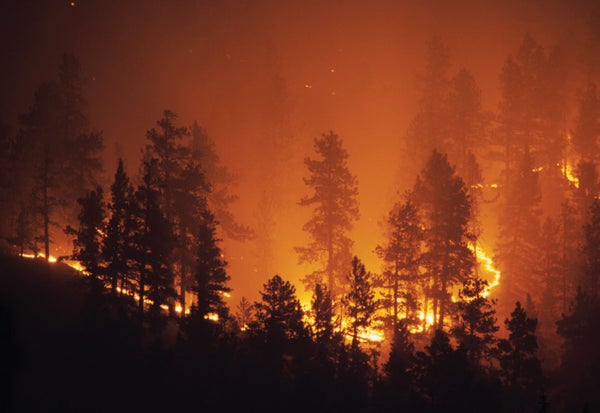
Wildfires have recently devastated regions across the world, and their severity is increasing. Hoping to reduce harm, researchers led by Yapei Wang, a chemist at Renmin University of China, say they have developed an inexpensive sensor to detect such blazes earlier and with less effort.
Current detection methods rely heavily on human watchfulness, which can delay an effective response. Most wildfires are reported by the general public, and other alerts come from routine foot patrols and watchtower observers. Passing planes and satellites also occasionally spot something, but “the fire [first] appears on the ground,” Wang says. “When [you see] the fire from the sky … it is too late.”
The team says its new sensor can be placed near tree trunks' bases and send a wireless signal to a nearby receiver if there is a dramatic temperature increase. That heat also powers the sensor itself, eliminating the need to replace batteries. The key is molten salts called ionic liquids: an abrupt temperature change causes electrons to migrate within the liquids, creating electrical energy that triggers electrodes to send the signal. The team printed the substances onto ordinary paper to create a sensor for just $0.40, as described in June in ACS Applied Materials & Interfaces.
On supporting science journalism
If you're enjoying this article, consider supporting our award-winning journalism by subscribing. By purchasing a subscription you are helping to ensure the future of impactful stories about the discoveries and ideas shaping our world today.
Jessica McCarty, a geographer at Miami University in Ohio, who was not involved in the study, says places such as San Diego—where wildland and city meet—could potentially benefit from sensors like this. When a fire breaks out in a canyon that extends to someone's property, she says, with such a device, “you know that as a homeowner before the fire agency may have detected it.”
But improving coordination among the different agencies involved in firefighting is even more crucial to address, says Graham Kent, a seismologist at the University of Nevada, Reno, who was also not part of the study. Kent is director of ALERTWildfire, a network that uses cameras and crowdsourcing to watch for fires in California, Nevada and Oregon. “The whole way that you respond to a fire until it's put out is like a ballet,” he says. “You'd have to choreograph it just so,” with resources allocated at precisely the right time and place from detection to confirmation to dispatch to extinguishing. “Fire detection is just step one; if you blow steps two through 98, all that technology … just doesn't matter.”
Wang says his team's next steps are to extend the device's signal range beyond the current 100 meters, which can limit practical use, and to develop a protective shield for it. The transmitter's effectiveness, McCarty notes, will also need to be tested in the field.