
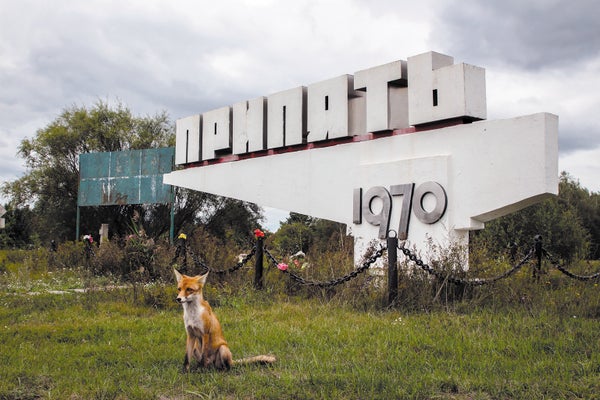
More than 30 years after the Chernobyl nuclear plant's meltdown, an 18-mile radius around the site remains almost entirely devoid of human activity—creating a haven for wildlife. But scientists disagree over lingering radiation's effects on animal populations in this region, called the Exclusion Zone. A new analysis, based on estimating the actual doses animals receive in various parts of the zone, supports the hypothesis that areas with the most radiation have the fewest mammals.
“The effects we saw are consistent with conventional wisdom about radiation,” says University of South Carolina biologist Timothy Mousseau, co-author of the new study in Scientific Reports. “What's surprising is that it took this long to start looking at this in a rigorous, comprehensive way.”
The paper reanalyzed data collected in 2009. At that time the same researchers used snow tracks to estimate the abundance of 12 mammal species, from mice to horses to wild boars, at 161 sites across 300 square miles in the Exclusion Zone. They found fewer mammals in areas with higher background radiation. Two subsequent studies, however, found no significant correlation between radiation levels and mammal abundance. But Mousseau and his colleagues say all three studies analyzed radiation exposure too simplistically.
On supporting science journalism
If you're enjoying this article, consider supporting our award-winning journalism by subscribing. By purchasing a subscription you are helping to ensure the future of impactful stories about the discoveries and ideas shaping our world today.
The previous studies relied solely on measurements of ambient radiation. For their reanalysis, the researchers used their original mammal counts—but they estimated the total radiation doses those animals would likely receive over their lifetimes, combining data about each species (including range size, diet and life span) with radiation levels based on soil samples and calculations about how the animals encounter radioactive molecules.
Again, they found that locations calculated as more radioactive had fewer mammals. Many past studies have linked radiation exposure at those estimated levels to deleterious genetic, physiological and reproductive effects, Mousseau says.
“This work is very important and is well done,” says Carmel Mothersill, a radiobiologist at McMaster University in Ontario, who was not involved in the study. “My own lab has used this approach to reanalyze data from Fukushima as well as Chernobyl, and it gives a much more meaningful relation between radiation exposure and risk of harm.”
But according to University of Georgia wildlife ecologist James Beasley, a co-author of past conflicting studies, the paper suffers from “critical flaws”—primarily in how the authors estimated animal abundance. Their original measurement locations, he says, were not spaced appropriately or extensively enough to draw conclusions about the entire area.
Karine Beaugelin-Seiller, study lead author and a radioecologist at the Institute for Radiological Protection and Nuclear Safety in France, agrees that uncertainty remains. Yet, she says, the study provides a more accurate way to establish the connection between radiation exposure and effects, ideally guiding future research.