
By Will Dunham
WASHINGTON, Oct 27 (Reuters) - Scientists have conducted a meticulous genetic comparison of humankind's closest living relatives, chimpanzees and bonobos, and found that much as humans once interbred with Neanderthals long ago these two ape species also were kissing cousins.
Scientists said on Thursday their analysis of the genomes of 65 chimpanzees and 10 bonobos from 10 African countries indicated two episodes of interbreeding between the species, one about 500,000 years ago and another about 200,000 years ago.
On supporting science journalism
If you're enjoying this article, consider supporting our award-winning journalism by subscribing. By purchasing a subscription you are helping to ensure the future of impactful stories about the discoveries and ideas shaping our world today.
The study determined that the two endangered forest-dwelling species, which behave differently despite their similar appearance, diverged from a common ancestor about 1.5 to 2 million years ago.
Scientists had thought interbreeding between chimpanzees and bonobos would have been unlikely because the Congo River, one of the world's largest, physically separates their geographical ranges.
The interbreeding had a lasting genetic impact on two of the four sub-species of chimpanzees, with about 1 percent of their genomes derived from bonobos.
"It is important to study our closest living relatives, as they provide valuable insight and allow a parallel comparison to our own species evolution," said Christina Hvilsom, a Copenhagen Zoo researcher who helped lead the study published in the journal Science.
The findings revealed a similar scenario to the interbreeding that occurred between our species and Neanderthals tens of thousands of years ago that has been documented in genetic research, added study co-leader Tomas Marques-Bonet of the Catalan Institution for Research and Advanced Studies and Institute of Evolutionary Biology in Spain.
The various non-African human populations have been found to possess 1.5 to 4 percent Neanderthal genetic ancestry.
Humankind's evolutionary lineage split from the chimpanzee and bonobo line about 5 to 7 million years ago. Our species appeared about 200,000 years ago.
The study also found genetics can be used to pinpoint where in the wild a chimpanzee comes from, a potentially valuable conservation tool, Marques-Bonet said.
Chimpanzees live in 22 countries in equatorial Africa. Bonobos can be found only in the Democratic Republic of Congo, south of the Congo River.
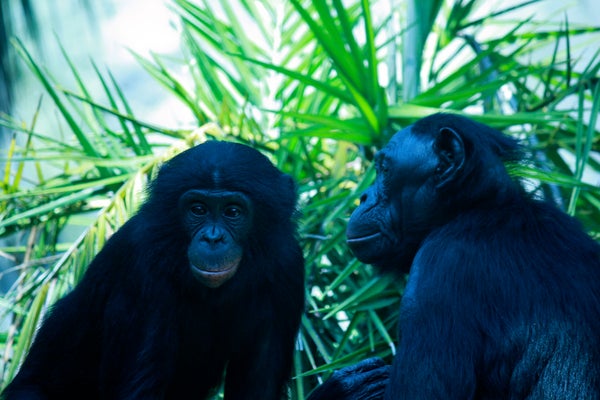
Bonobos are a bit smaller, more slender and darker in color than chimpanzees. The groups are dominated by females, with females forming tight bonds against males through same-sex social and sexual contact that is thought to limit aggression. Unlike chimpanzees, they tend not to exhibit lethal aggression against other bonobos.
Chimpanzee groups are dominated by males. Intense aggression between different groups can be deadly, with even infants of other groups killed. Chimpanzees use tools extensively compared to bonobos, and also cooperatively hunt small monkeys as prey.