
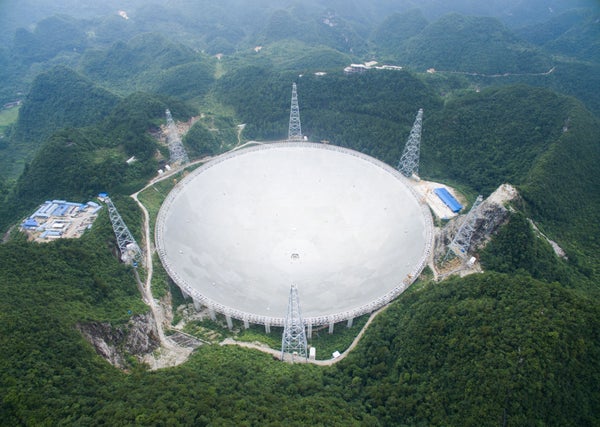
China has put the finishing touches on the world's biggest radio telescope, whose 1,650-foot-wide dish will scan the heavens for signs of intelligent alien life, among other tasks.
On Sunday (July 3), technicians installed the last of the 4,450 panels that make up the Five-hundred-meter Aperture Spherical Telescope's (FAST) giant dish, China's state-run Xinhua news agency reported.
Project team members will soon begin testing and debugging FAST, after which Chinese scientists will use it for "early-stage research," Xinhua reported. But the instrument will be available to researchers around the world when that phase is over—likely two to three years from now.
On supporting science journalism
If you're enjoying this article, consider supporting our award-winning journalism by subscribing. By purchasing a subscription you are helping to ensure the future of impactful stories about the discoveries and ideas shaping our world today.
With a dish the size of 30 football fields, FAST is by far the largest single-aperture telescope in the world (though arrays that link up multiple radio dishes cover more ground). The previous record holder in the field is the 1,000-foot-wide (300 meters) Arecibo Observatory in Puerto Rico.
FAST was built in China's Guizhou Province, more than 1,240 miles (2,000 kilometers) southwest of Beijing. The 1.2-billion-yuan ($180 million) facility should help scientists learn more about the universe's early days, detect low-frequency gravitational waves and hunt for signals that may have been produced by distant alien civilizations, project officials said.
"As the world's largest single-aperture telescope located at an extremely radio-quiet site, its scientific impact on astronomy will be extraordinary, and it will certainly revolutionize other areas of the natural sciences," said FAST Project chief scientist Nan Rendong, according to Xinhua.
"FAST's potential to discover an alien civilization will be 5 to 10 times that of current equipment, as it can see farther and darker planets," added Peng Bo, director of the National Astronomical Observatories' (NAO) Radio Astronomy Technology Laboratory. (The NAO, part of the Chinese Academy of Sciences, built FAST.)
The FAST site was once home to a village of 65 people, who were relocated in 2009, according to Xinhua. The Chinese government plans to resettle an additional 9,110 people currently living within 3 miles (5 km) of the telescope by the end of September, the news agency added.
Copyright 2016 SPACE.com, a Purch company. All rights reserved. This material may not be published, broadcast, rewritten or redistributed.