
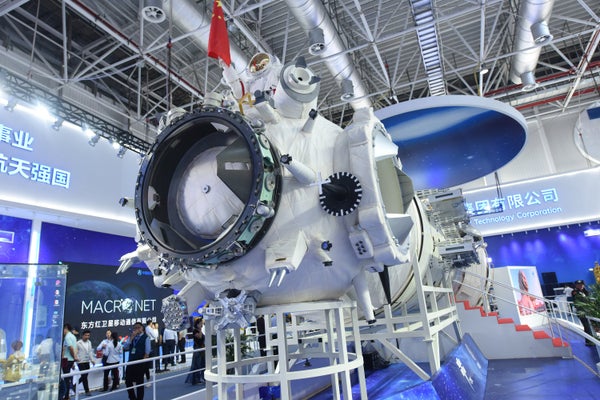
China has selected nine scientific experiments—including a project that will probe how DNA mutates in space—to fly on its first major space station, scheduled to be completed in 2022.
The China Manned Space Agency selected the projects, which involve scientists from 17 nations, from 42 hopefuls, in a process organized with the United Nations Office for Outer Space Affairs (UNOOSA).
China’s existing space laboratory, Tiangong-2, which launched in 2016, also hosts experiments, but the new space station will be bigger and is intended to last longer. Known as the China Space Station, the outpost will be less than one-quarter of the mass of the International Space Station (ISS).
On supporting science journalism
If you're enjoying this article, consider supporting our award-winning journalism by subscribing. By purchasing a subscription you are helping to ensure the future of impactful stories about the discoveries and ideas shaping our world today.
The science projects cover similar topics to experiments that have flown on the ISS since its launch in 1998, including fluid and fire behavior, biology and astronomy.
Scientists working on the projects hail from spacefaring nations such as Russia, Japan and India, as well as low- and middle-income countries including Kenya, Mexico and Peru—the result of a special effort to encourage participation from such nations. “The cooperation takes into account the special needs of developing countries, which were encouraged to submit joint project applications with developed countries,” said Wang Qun, China’s ambassador to the United Nations in Vienna, in a statement.
The experiments include an Indian-Russian observatory called Spectroscopic Investigations of Nebular Gas, which will map dust clouds and star-forming regions of space using ultraviolet light. A group of European institutions, meanwhile, will study how microgravity and radiation in space affect the mutation of DNA in human “organoids”—3D biological structures that mimic organs. And a Saudi Arabian team will test how solar cells perform on the outside of the space station.
Other winners include a detector called POLAR-2, a more powerful follow-up to a sensor launched on Tiangong-2 to study the polarization of energetic γ-ray bursts from distant cosmic phenomena. POLAR-2, which will be built by an international collaboration, could even allow astronomers to observe the weak radiation associated with sources of gravitational waves.
But none of the experiments come from the United States, which since 2011 has forbidden NASA researchers from collaborating with China without congressional approval. A spokesperson for UNOOSA told Nature that U.S. scientists were eligible to take part and were involved in several applications, but those projects weren’t ultimately selected.
The United States is planning to cut its funding for the ISS from 2024, as it concentrates its space efforts on building an outpost in the moon’s orbit from 2022. This could mean that the Chinese space station becomes scientists’ only laboratory in low Earth orbit from 2024.
This article is reproduced with permission and was first published on June 17, 2019.