
China’s greenhouse gas emissions are on a downward trajectory, but its emissions may not have fallen quite as much over the past two years as the Chinese government and the International Energy Agency have suggested.
That’s the conclusion of a new study published in the journal Nature Climate Change, which says China’s emissions may have actually increased in 2014, rather than fallen.
The International Energy Agency estimated last year that both the decline in China’s coal use and falling electricity demand reduced its carbon dioxide emissions by 1.5 percent in 2014, leading to a 0.2 percent reduction in global emissions.
On supporting science journalism
If you're enjoying this article, consider supporting our award-winning journalism by subscribing. By purchasing a subscription you are helping to ensure the future of impactful stories about the discoveries and ideas shaping our world today.
The actual emissions picture may be a bit more complicated, however.
“We estimate that China’s carbon dioxide emissions in 2014 actually increased by approximately 0.5 percent,” said study co-author Robbie Andrew, a researcher at the Center for International Climate and Environmental Research, or CICERO, in Oslo, Norway.
China is the world’s largest greenhouse gas emitter in part because it is the world’s greatest burner of coal for electricity. Coal is the globe’s leading source of greenhouse gas emissions driving climate change.
Estimates of China’s greenhouse gas emissions are based in large part on official Chinese reports on the amount of coal it burns—data that China’s government routinely revises over time, affecting scientists’ estimates of the country’s greenhouse gas emissions.
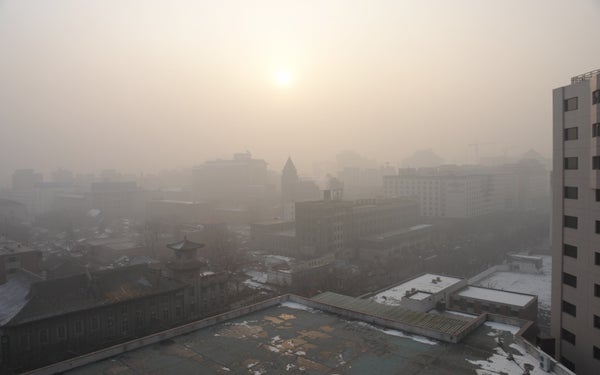
China has reported that its coal use fell 2.9 percent in 2014 when measured by weight, and 3.7 percent in 2015. The decline comes as the country grapples with a struggling economy, choking urban air pollution and a need to reduce greenhouse gas emissions to uphold its end of the Paris climate agreement.
But a reduction in coal use doesn’t necessarily translate into lower carbon dioxide emissions from coal-fired power plants.
Carbon dioxide emissions depend mainly on the energy content of coal, not how much it weighs. China is burning more energy-dense coal, meaning that carbon dioxide emissions decrease less than the amount of coal burned, Andrew said.
The study, published Monday, shows that even though China decreased its coal consumption 2.9 percent in 2014, revised statistics show that coal energy consumption went down by just 0.7 percent that year, leading to a net increase in emissions of 0.5 percent.
Despite that increase in 2014, the study concludes that China’s emissions are likely to have decreased in 2015. Another study published this month suggested China’s emissions may have peaked already.
“Our estimates show that the growth in Chinese emissions has slowed a lot in the past two to three years, and is now much lower than at any point since the early 2000s,” said study lead author Jan Ivar Korsbakken, senior climate economics researcher at CICERO. “There is a lot of uncertainty in the numbers, but we show that this slowdown is almost certainly real.”
The study says very little about future trends in China’s emissions, he said.
IEA spokesman Greg Frost said it usually takes two years for the agency to fully account for most countries’ energy use and carbon emissions. A full accounting for 2014 will be released this summer, he said.
Scientists unaffiliated with the study said it highlights the uncertainty in data released by the Chinese government.
“The broader context is skepticism of China's reported coal consumption and CO2 emissions,” said Rob Jackson, a Stanford University earth systems science professor. “They've tended to revise their estimates upwards retroactively. The most important part of the new paper is the authors' confirmation that fundamental changes are underway in China's coal use. That's good news for everyone, and I agree with them."
Ranping Song, developing country climate action manager for the World Resources Institute, said that he has a technical quibble with the study’s specific estimate of China’s emissions growth in 2014, but he agrees with its general conclusion.
Some of China’s data is uncertain, but there is clearly a downward trend in both China’s energy and coal consumption, he said.
“Instead of focusing on the exact timing of China’s emission peak, the more important question is whether China is building a foundation for deep decarbonization over the long term,” Song said. “The debate, therefore, should focus on measures that will enable recent trends to last in a sustainable manner.”
This article is reproduced with permission from Climate Central. The article was first published on March 29, 2016.