
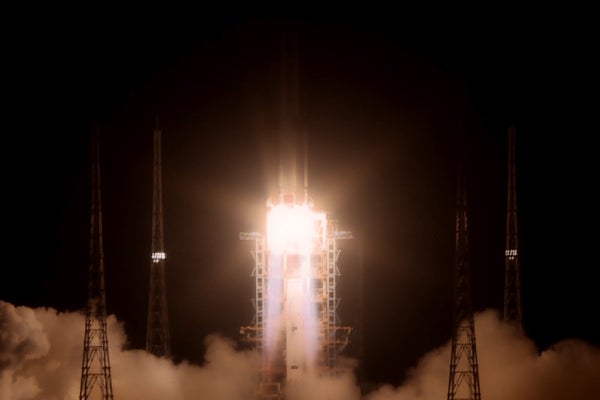
China has apparently landed on the moon again — and this time the country plans to bring home some souvenirs.
Chang'e 5, China's first-ever sample-return mission, successfully touched down today (Dec. 1), according to state media reports. Details on the landing were not immediately available from the China National Space Administration, but the state-run CGTN news channel announced the landing success in a single-sentence statement.
Chang'e 5's landing was expected to occur at about 10:13 a.m. EST (1513 GMT) near Mons Rümker, a mountain in the Oceanus Procellarum ("Ocean of Storms") region of the moon.
On supporting science journalism
If you're enjoying this article, consider supporting our award-winning journalism by subscribing. By purchasing a subscription you are helping to ensure the future of impactful stories about the discoveries and ideas shaping our world today.
Two pieces of the four-module, 18,100-lb. (8,200 kilograms) Chang'e 5 mission hit the gray dirt today — a stationary lander and an ascent vehicle. If all goes according to plan, the lander will spend the next few days collecting about 4.4 lbs. (2 kg) of lunar material, some of it dug from up to 6.5 feet (2 meters) beneath the lunar surface.
The sample will then be transferred to the ascent vehicle, which will launch to lunar orbit and meet up with the other two Chang'e 5 elements — an orbiter and an Earth-return craft. The return vehicle will haul the moon dirt and rocks to our planet, with a touchdown planned in Inner Mongolia in mid-December.
That will be a landmark event; pristine lunar samples have not been delivered to Earth since 1976, when the Soviet Union's Luna 24 mission came home with about 6 ounces (170 grams) of material.
Chang'e 5 just launched on Nov. 23, so it's packing a lot of action into a few short weeks. The compressed timeline is driven largely by the mission's energy needs: The Chang'e 5 lander is solar powered, so it must get all of its work done in two Earth weeks at most, before the sun sets at Mons Rümker. (One lunar day lasts about 29 Earth days, so most moon sites receive two weeks of continuous sunlight followed by two weeks of darkness.)
Chang'e 5 is the latest mission in the Chang'e program of robotic lunar exploration, which is named after a moon goddess in Chinese mythology. The Chang'e 1 and Chang'e 2 orbiters launched in 2007 and 2010, respectively, and Chang'e 3 put a lander-rover duo down on the moon's near side in December 2013.
The Chang'e 5 T1 mission sent a prototype return capsule around the moon and back to Earth in October 2014 to help prepare for Chang'e 5. And in January 2019, the Chang'e 4 lander-rover duo pulled off the first-ever soft touchdown on the moon's mysterious, largely unexplored far side. Both Chang'e 4 robots remain operational today, as does the Chang'e 3 lander.
Though Chang'e 5's operational life will be short, the mission is designed to have a long-lasting impact. After all, scientists are still studying the 842 lbs. (382 kg) of lunar material brought to Earth by NASA's Apollo missions from 1969 to 1972.
Some of the Apollo material came from Oceanus Procellarum, a huge volcanic plain that Apollo 12 explored in late 1969. But Mons Rümker rocks formed just 1.2 billion years ago, whereas all of the samples collected by the Apollo astronauts are more than 3 billion years old.
Chang'e 5 therefore "will help scientists understand what was happening late in the moon's history, as well as how Earth and the solar system evolved," the nonprofit Planetary Society wrote in its description of the mission.
Chang'e 5 isn't the only sample-return game in town. Japan's Hayabusa2 mission is scheduled to deliver pieces of the asteroid Ryugu to Earth on Dec. 5, and NASA's OSIRIS-REx probe collected samples of the space rock Bennu in late October. The Bennu samples are scheduled to come home in September 2023.
Copyright 2020 Space.com, a Future company. All rights reserved. This material may not be published, broadcast, rewritten or redistributed.