
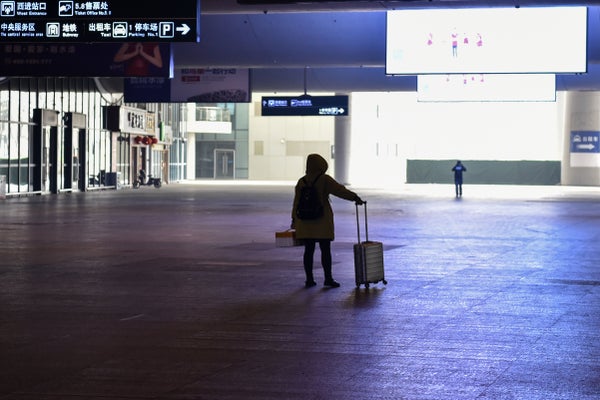
The novel coronavirus outbreak that apparently started in China’s massive city of Wuhan has now spread to other parts of that nation and several countries beyond it, including the U.S. As of late this week, health officials said the virus had infected more than 1,000 people, causing at least 41 deaths in China. Chinese authorities have responded by shutting down all travel into and out of Wuhan and about a dozen other cities, restricting the movements of around 35 million people.
The restrictions—which are occurring during the Chinese New Year holiday, when millions of people usually travel to visit their families—are an attempt to prevent the virus from spreading further within China, where the vast majority of cases have so far been concentrated. But experts are split on whether this approach is effective or fair to the residents of the affected cities.
“As far as I know, trying to completely cut out travel from an area of that size—if it’s not unprecedented, it’s close,” says Chandy John, former president of the American Society of Tropical Medicine and Hygiene and a professor of pediatrics at Indiana University. “I’m not aware of anything that’s been that drastic for [such an area] in the past.”
On supporting science journalism
If you're enjoying this article, consider supporting our award-winning journalism by subscribing. By purchasing a subscription you are helping to ensure the future of impactful stories about the discoveries and ideas shaping our world today.
The action raises a number of potential issues, including “basic human rights concerns about restricting a group of people who are within an epidemic area to that area,” John says. Additionally, “if you do something like this, getting health supplies into the city, getting care for the people in the city who are sick—all of that’s going to be more difficult. And of course, those who are in the city who aren’t sick—and can’t leave—may be more exposed than they would be if they could leave.” The New York Times reported that people in Wuhan were experiencing long waits for medical care, that some were sent home without a thorough exam or treatment and that some residents had limited access to fresh food because so many shops and markets were closed. John says that in a city as large as Wuhan, which has a population of more than 11 million, some people may still find ways to leave. And they might not want to tell others where they are coming from, which could make it harder to trace potential infections.
On the other hand, John says, “it is still relatively early in the outbreak, and so prevention of travel is one effective way of containing it to an area—especially since [Wuhan] seems to be a major hub for transport and travel in China.” The travel shutdown lowers the risk of residents of Wuhan or nearby cities carrying the virus elsewhere, and it makes it less likely that people who visit will acquire the pathogen and spread it when they return home. “From that standpoint, I think it could be effective in reducing the spread,” John says. But something less draconian than restricting all travel—such as telling individuals with symptoms of the infection to stay in their home—“could have a big bang for the buck without all the downsides of the travel restrictions,” he says.
Other experts did not express the same qualms about the quarantines. “Very few countries could pull it off. China is one of the ones that can,” says Arthur Caplan, a bioethicist at New York University Grossman School of Medicine. But should they? “My attitude here is yes,” he says. “We don’t know whether this is a big risk or small risk,” Caplan adds. “Anytime you get a new mutation [in a virus], though, that looks like it’s person-to-person and could be fatal due to pneumonia—I think that’s something to pay immediate attention to.” Furthermore, he says, “it isn't particularly intrusive to be told you have to stay in a city of 11 million people—that's hardly being chained to your apartment... So I don’t see this as some kind of gigantic civil liberties intrusion. I see it as prudent.”
But quarantining an entire large city—or multiple cities—is not an approach that would work in many other places. “You’re not going to quarantine the city of New York, ever,” Caplan says, noting that U.S. authorities could not even effectively enforce a quarantine imposed on one nurse who returned to the country after treating Ebola patients in Sierra Leone in 2014. Whether it is more effective to quarantine cities, as China has done, or to simply ask individuals who feel sick to stay home is a matter of culture, he says.
When a government decides to quarantine someone, it should ensure that those affected have a tolerable quality of life, Caplan says. If a person is kept in a room with no television, bad heat and no running water, for example, that is unacceptable. But not allowing someone to leave a city of 11 million is “not especially burdensome,” he says—at least until more is known about the virus and how lethal it is.
A second U.S. case of the new coronavirus was confirmed on Friday in Illinois. Cases of human-to-human transmission have been reported in China, including chains of up to four people. Most of those who died were older and had underlying health problems. So far, the World Health Organization has declined to declare the outbreak a public health emergency of international concern, although it has said that decision could change as more information becomes available.