
An automotive chip shortage has led to production cuts around the globe, just as many carmakers are gearing up to expand their fleets of electric vehicles.
The shortage is a result of pandemic-related constraints on supply chains and other factors. And it could prolong the world's sluggish transition to electric vehicles if chips remain scarce in the coming months, experts say.
"If we've got an ongoing chip shortage for an extended period of time, that means those [electric] vehicles can't get built, and they can't get sold, and we continue to have more older vehicles staying on the road longer," said Sam Abuelsamid, an analyst at the market research firm Guidehouse Insights. "So that's definitely a problem."
On supporting science journalism
If you're enjoying this article, consider supporting our award-winning journalism by subscribing. By purchasing a subscription you are helping to ensure the future of impactful stories about the discoveries and ideas shaping our world today.
That would delay the decarbonization of the emissions-intensive transportation sector, an effort most scientists believe is necessary to avoid the worst impacts of climate change.
The transportation sector accounted for 29 percent of the roughly 6.6 billion metric tons of carbon dioxide-equivalent emissions produced by the United States in 2019, according to EPA data. And personal vehicles — cars, pickup trucks, SUVs and minivans — produced over half of the sector's emissions.
The Biden administration is working to cut emissions from personal vehicles. Electric vehicles, which last year made up 2 percent of U.S. auto sales, are central to that plan.
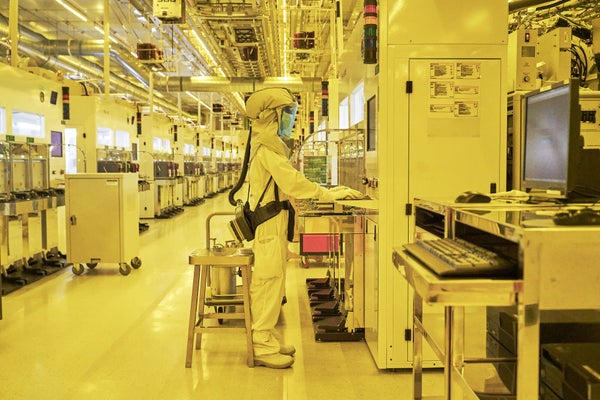
The chip shortage is a key issue for Vice President Kamala Harris as she visit's Singapore, where U.S.-headquartered manufacturer GlobalFoundries is building a chip fabrication plant.
"And if we’re not producing enough semiconductors as a world, as a globe, our automobile factories in the United States will be impacted as they've been," she said today in a press conference with Prime Minister Lee Hsien Loong. "You just ask anybody who's thinking about trying to buy a new car or a used car, and it is more difficult than it has been in a long time because, of course, supply chain issues impact production lines and impact goods getting to market."
President Biden recently issued an executive order calling for half of new cars sold by 2030 to be EVs or plug-in hybrids. He also unveiled draft fuel efficiency rules that would require new internal-combustion engine vehicles to cut their emissions.
But experts are skeptical about whether the administration's rules would be enough to hit the 50 percent electric vehicle goal Biden set for the end of this decade, especially with the chip shortage complicating what was already an ambitious timeline (Climatewire, Aug. 6).
"EVs are still a very tiny part of the market, and they're going to be a small part of the market for some years," said Michelle Krebs, an analyst with the car dealer conglomerate Cox Automotive.
The chip shortage has begun to delay production of some popular EVs. Earlier this month, Ford Motor Co. told customers who have placed orders for Mach-E Mustangs that "the global semiconductor chip shortages are affecting our ability to keep up with demand." As a result, the company said, deliveries of the electric sports cars would be delayed by at least six weeks.
A bigger concern for Ford, and EV advocates, is the fate of the F-150 Lightning, the electric version of its best-selling pickup (Energywire, May 21).
Because the Lightning isn't in full production, "it hasn't been affected yet," Abuelsamid said. "Depending on how long this goes on, yes, it could very well be affected."
And that's the rub: No one yet knows how long the chip shortage will last.
It began as a result of a pandemic-driven spike in demand for chip-intensive personal computers and gaming consoles. That moved automakers, which rely on the same chip-making companies for silicon wafers, to the back of the queue.
The line, meanwhile, has gotten longer as a result of a warehouse fire, a drought and other incidents at key chip-making facilities.
"The situation is very fluid," Krebs said. "We thought it would be easing by now, and it seems to be just as bad and possibly worsening over the next few months. We're trying to figure out when does it bottom out, and I just don't have the answer for that."
Reprinted from E&E News with permission from POLITICO, LLC. Copyright 2021. E&E News provides essential news for energy and environment professionals.