
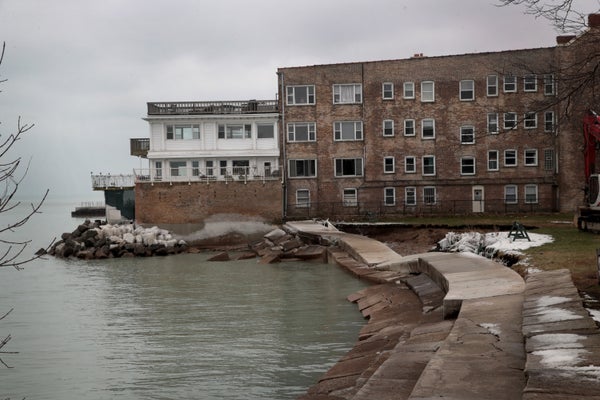
Cities on the Great Lakes and St. Lawrence River will face nearly $2 billion in damages from climate change through 2025, according to a new survey of municipalities in the basin.
That's on top of nearly $880 million spent since 2019 as the world's largest freshwater system experiences more extreme weather events, unpredictable swings in lake levels, and changes in precipitation and evaporation rates, officials said.
"High water levels, paired with severe storm events and wave action, are leading to greater erosion and flooding that threaten public and private properties, critical infrastructure, and recreation and tourism amenities in shoreline communities," said Walter Sendzik, chair of the Great Lakes and St. Lawrence Cities Initiative and mayor of St. Catharines, Ontario.
On supporting science journalism
If you're enjoying this article, consider supporting our award-winning journalism by subscribing. By purchasing a subscription you are helping to ensure the future of impactful stories about the discoveries and ideas shaping our world today.
The survey of 241 municipalities — from large cities to villages — found that 99% of responding communities witnessed consistent or rising interest in coastal zone issues, while more than 8 in 10 respondents said water level and flooding forecasts are "very important to their jurisdiction's work on coastal planning."
Yet only 27% of respondents said their municipalities have staff that are "highly knowledgeable" of coastal issues, and only 11% reported having high capacity to respond to such issues.
While the Great Lakes have always seen rising and falling water levels, usually over decadal cycles, and are famously stormy, experts say conditions are becoming more variable and that past events and conditions do not necessarily inform the lakes' future (Greenwire, March 21, 2019).
In July 2019, for example, water levels on Lake Michigan soared to nearly 3 feet above mean summer levels, causing severe erosion on the lake's eastern shore where homes sit perilously close to the water's edge (Climatewire, Aug. 22, 2019).
Big cities like Chicago and Milwaukee also have seen infrastructure damage from high water, wave action and seasonal storms (Climatewire, Nov. 26, 2019). Lake Erie faces perennial risk from toxic algae blooms, a problem linked to agricultural runoff and warmer water temperatures (Climatewire, Nov. 1, 2019).
Don Wuebbles, professor of atmospheric science at the University of Illinois and a nationally recognized expert on the Great Lakes, said climate change will affect shoreline communities in various ways, most notably rising and falling lake levels due to changes in precipitation and evaporation.
"What sounds like global warming is not just a trivial increase in temperature, it really is about extreme events," he said.
The Great Lakes cities initiative, along with other regional organizations, say funding from federal, state and local governments — in both the United States and Canada — will be essential to help communities adapt to changing conditions.
The Biden administration's $1.2 trillion infrastructure package, currently before Congress, could provide critical funding for adaptation and resilience projects, officials said. "Our coastal infrastructure is vital to the economic and recreational health of our communities, and coordinated action is required," Milwaukee Mayor Tom Barrett (D) said in a statement.
Reprinted from E&E News with permission from POLITICO, LLC. Copyright 2021. E&E News provides essential news for energy and environment professionals.