
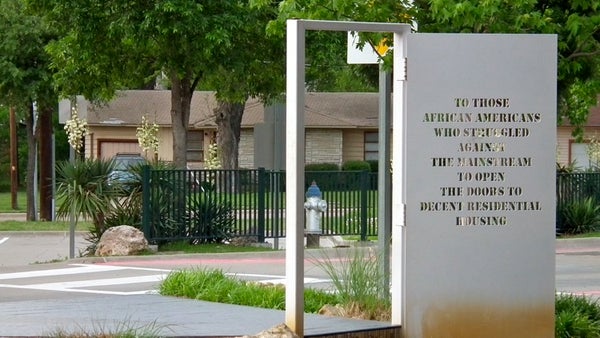
We asked Scientific American readers, as part of our special issue on cities coverage this month, to send us pictures they have taken of a science or engineering infrastructure scene outside their windows that illustrates the best or worst aspect of city life.
This offering came from Ted A. Campbell, associate professor of church history at Southern Methodist University's Perkins School of Theology. This installation at the Forest Lane Station in the Dallas Area Rapid Transit system commemorates the Hamilton Park neighborhood, built in 1953 to serve the needs of the region's growing black professional community, Campbell says. "The city decided to bulldoze a substantial part of a historically black neighborhood in Dallas to accommodate a new runway at Love Field [airport]," he adds. "Black leaders, including Dr. Richard T. Hamilton, struggled with civic leaders to secure new residential housing for black professional families. The neighborhood turned out to be a huge success, financially and otherwise."
Campbell took this photo on April 17, 2011.
On supporting science journalism
If you're enjoying this article, consider supporting our award-winning journalism by subscribing. By purchasing a subscription you are helping to ensure the future of impactful stories about the discoveries and ideas shaping our world today.
Want to join in? Please send your photograph, a description of how it illustrates the best or worst aspect of life in your city, and the date it was taken to submit@sciam.com