
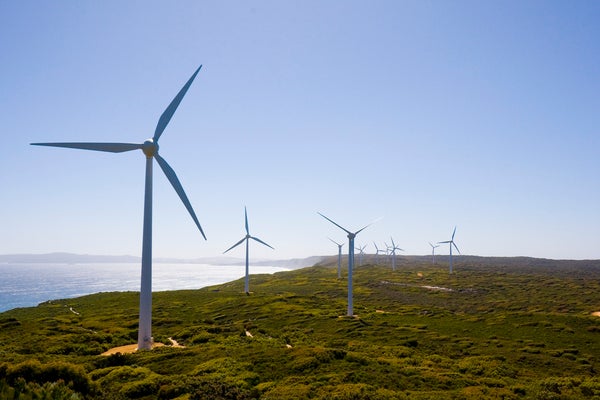
Renewable energy generation grew globally by 161 gigawatts in 2016, setting another annual record for capacity additions and pushing clean power capacity past 2,000 GW, according to newly released data from the International Renewable Energy Agency.
That’s roughly double the amount of renewable energy that was flowing across the world’s power grids a decade ago, according to the Abu Dhabi, United Arab Emirates-based organization, and it reflects the unprecedented adoption of solar, wind, hydro and other emissions-free power by the world’s largest economies.
China, Europe and the United States now account for 62 percent of the world’s total installed renewable capacity, with China and the United States supporting the largest clean power portfolios, according to the data. Other leaders are Brazil, Germany, Canada and India.
On supporting science journalism
If you're enjoying this article, consider supporting our award-winning journalism by subscribing. By purchasing a subscription you are helping to ensure the future of impactful stories about the discoveries and ideas shaping our world today.
Asia was the fastest-growing region year over year, with a 13.1 percent increase in renewable energy capacity. Africa installed 4.1 GW of new capacity in 2016, a 12 percent jump from 2015.
In addition to boosting the world’s carbon-free electricity, which experts say is essential to arresting global warming, the surge in renewables “provides multiple socio-economic benefits in terms of fueling economic growth, creating jobs and improving human welfare and the environment,” Adnan Amin, IRENA’s director-general, said in a statement.
The 2016 growth represents an 8.7 percent jump in global renewable energy capacity from 2015, according to IRENA. Solar was the largest source of new renewable energy for the year, estimated at 71 GW, followed by wind power at 51 GW and hydropower at 30 GW.
Hydropower saw its greatest expansion in Asia, Africa and South America, while solar and wind installations were more broadly distributed, with China and the United States leading the world in year-over-year expansions for the two leading non-hydro renewable energy resources. Solar also saw multigigawatt expansions in India, Japan and the United Kingdom. India, Germany and Brazil each added more than 2 GW of wind power capacity in 2016, according to the data.
Notably, offshore wind energy saw its second-largest annual growth in 2016, with China nearly tripling its capacity in 12 months, from 559 to 1,480 megawatts. New offshore turbines also came online in Germany, the Netherlands, Great Britain and the United States.
Reprinted from Climatewire with permission from E&E News. E&E provides daily coverage of essential energy and environmental news at www.eenews.net.