
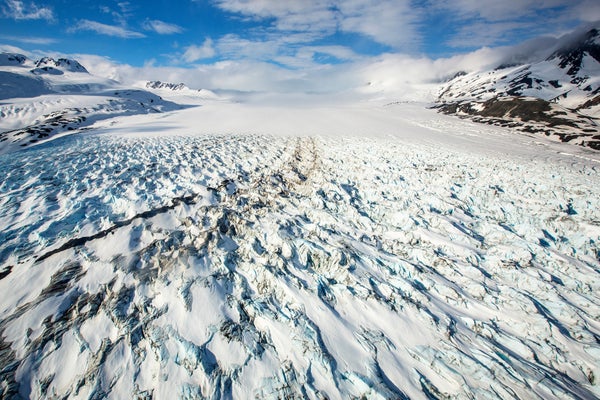
Snowfall in south-central Alaska has dramatically increased over the last 150 years because of climate change, scientists said in a report released yesterday.
According to the study published in the journal Scientific Reports, summer snowfall has risen by about 49 percent since the mid-19th century, and winter snowfall has increased by a whopping 117 percent.
It may sound counterintuitive—after all, Alaska is experiencing the fastest rate of warming in the country, and the central part of the state has already seen its temperatures climb by 2 to 3 degrees over the last 50 years. But warmer air can hold more moisture, the researchers say, allowing for greater amounts of precipitation, including snow.
On supporting science journalism
If you're enjoying this article, consider supporting our award-winning journalism by subscribing. By purchasing a subscription you are helping to ensure the future of impactful stories about the discoveries and ideas shaping our world today.
Scientists say it's not just the local warming that's played a role. The study suggests that rising temperatures in the western Pacific and Indian oceans might be an even bigger factor, helping to strengthen a low-pressure system in the Gulf of Alaska that drives warm, moist air—perfect conditions for snowstorms—north across the state. It's another reminder that the effects of climate change in one location can sometimes produce rippling effects around the world.
"There are not that many records—and certainly not that many annually resolved records, where you can see year-to-year changes in snowfall—that go back farther into time," said Dominic Winski of Dartmouth College, the study's lead author. Recent records have suggested a change in Alaskan snowfall patterns, but the new study is among the first to demonstrate that the last century's changes are the most dramatic the region has seen in at least 1,000 years.
To investigate long-term snowfall patterns, the researchers climbed 13,000 feet up the side of Alaska's Mount Hunter, located in the famous Denali National Park and Preserve. There, they drilled out two cores of centuries-old ice from the side of the mountain and brought them back to the lab for analysis. Ice cores are a well-established tool for climate scientists—the bubbles of air and other particles trapped inside them contain all kinds of clues about the location's weather and climate at the time of freezing.
In this case, the ice cores suggested that annual snowfall in the area has doubled since the year 1840, with the greatest growth seen during the winter. The long-term record provided by the ice cores suggests that the recent spike "is unique, at least in the last 1,200 years," according to Winski.
The dramatic increase was a surprise at first, he added—the rise in snowfall was too great to be explained by Alaska's warming air alone. But once the researchers began investigating other potential causes, including the low-pressure system in the Alaskan Gulf, the pattern began to make sense. The researchers found that wetter winters in the Mount Hunter record were associated with the intensity of the low-pressure system, which in turn is correlated with rising sea-surface temperatures in the Pacific and Indian oceans.
"When there's warmer temperatures in the tropical ocean, that leads to enhanced convection—basically, air rising up into the upper atmosphere—and that creates a sort of anomaly that propagates through the atmosphere," Winski said. In south-central Alaska, the result is an increase in storms.
The scientists say that precipitation is being affected in other areas than just Alaska. Even as the warming oceans are bringing more snow to Denali, other research has suggested that they may also be causing a decrease in Hawaiian rainfall at the same time. In Alaska, the new study provides some of the starkest evidence yet of the region's continuous response to human-caused climate change, corresponding with 150 years of greenhouse gas emissions.
"This is one of the clearest records that's available showing this dramatic rise in precipitation during the industrial era," Winski said.
Correction: An earlier version of this story incorrectly identified Mount Hunter as the tallest peak in North America.
Reprinted from Climatewire with permission from E&E News. E&E provides daily coverage of essential energy and environmental news at www.eenews.net.
