
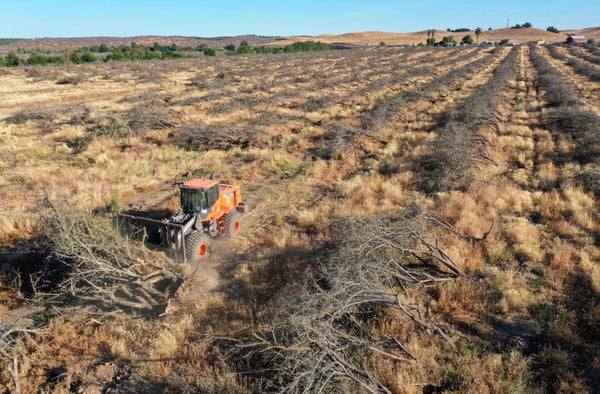
Sweltering temperatures exacerbated by climate change dealt a multibillion-dollar blow to U.S. farmers and the public insurance program that shields them from devastating losses.
Those costs threaten to take a toll on the domestic agriculture sector and American taxpayers, who subsidize the federal insurance program that insulates farmers from financial shocks such as plunging crop prices and yield volatility, according to new research.
A recent study in Environmental Research Letters by Stanford University climate scientists examined global warning's impact on the U.S. crop insurance program, which Congress established in the 1930s to revive domestic agriculture in the wake of the Dust Bowl.
On supporting science journalism
If you're enjoying this article, consider supporting our award-winning journalism by subscribing. By purchasing a subscription you are helping to ensure the future of impactful stories about the discoveries and ideas shaping our world today.
The findings were stark.
Climate-fueled temperature increases generated an estimated $27 billion in insurance payments to farmers between 1991 and 2017, the study found. Those losses accounted for nearly 20% of the program's total payouts over that period.
And those numbers are expected to rise as climate change intensifies.
“This is further evidence that global warming is impacting people and ecosystems already, and it’s further evidence that [climate change] is having financial costs that are in the billions,” said Noah Diffenbaugh, a professor of earth system science at Stanford.
“And that’s important for understanding climate change, understanding climate risks and ... for evaluating the value of both mitigation and adaptation actions,” Diffenbaugh added.
Using temperature records and Department of Agriculture data on crop insurance payments, or indemnities, the researchers examined the relationship between insurance losses and temperature variations at the county level during all 26 growing seasons. Then, using climate model simulations, they calculated the insurance losses that would have occurred in a hypothetical scenario — also known as “counterfactual” — in which global warming didn’t exist.
By comparing “actual indemnities and the counterfactual indemnities aggregated across all the years and all the counties for the whole [United States],” Diffenbaugh said, his team was able to attribute $27 billion in insurance claims and payments to climate-related trends.
“This approach quantifies whether indemnities in a given county are higher or lower in a year in which temperature or precipitation is higher or lower than average for that county,” the researchers wrote.
In 2012, for instance — when much of the U.S. experienced an intense drought and record summer temperatures — crop indemnities surpassed $18 billion, making it the most costly year for the insurance program. The study estimated that climate-related temperature trends were responsible for $8.8 billion of those payments.
That’s a grim finding, Diffenbaugh said, given the growing body of research that shows “we can expect the kinds of conditions that happened in 2012 to happen a lot more frequently in the current climate — and even if the Paris Agreement goals are achieved and global warming is held below 2 degrees of warming.”
"The risks are rising," he said.
The study came as lawmakers and regulators pay heightened attention to the risks that global warming poses to economic sectors, the financial system and the global economy more broadly. President Biden signed an executive order in May that kick-started an administrationwide effort to address the risks posed by global warming to public and private assets.
Environmentalists, climate finance experts and some researchers maintain that the U.S. needs to prepare more quickly for the financial effects of rising temperatures.
“It's clear at this point that we are not adapted to the climate change that’s already happened,” Diffenbaugh said. “And as this study shows and as other studies have shown, it is costing us substantially.”
Reprinted from E&E News with permission from POLITICO, LLC. Copyright 2021. E&E News provides essential news for energy and environment professionals.