
An unusually busy Atlantic hurricane season is showing no signs of letting up.
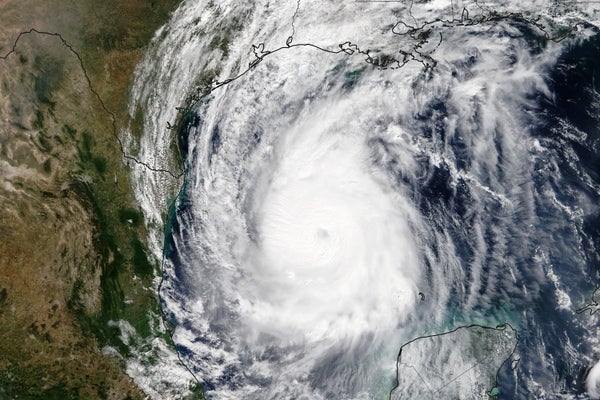
Hurricane Delta is currently churning toward the Gulf Coast, expected to make landfall in Louisiana later today. Delta is the 25th named storm this season and the ninth hurricane.
It’s the earliest in the year that any season has reached 25 storms.
On supporting science journalism
If you're enjoying this article, consider supporting our award-winning journalism by subscribing. By purchasing a subscription you are helping to ensure the future of impactful stories about the discoveries and ideas shaping our world today.
Delta is also the third storm this year to achieve “major hurricane” status—that is, Category 3 or higher. Delta reached Category 4 status Tuesday night before weakening as it moved over Mexico’s Yucatán Peninsula.
An average Atlantic hurricane season sees only 12 named storms, six of which typically become hurricanes and three of which grow into major hurricanes.
This year’s season already has exceeded two of those thresholds. And hurricane season doesn’t end until Nov. 30.
According to NOAA’s hurricane records, the 2020 season is inching closer to a record-breaking year.
The only year known to produce more Atlantic storms was 2005, which saw 27 named tropical storms and hurricanes and one unnamed subtropical storm. With nearly two months left in the season, it’s possible 2020 could break the record for total number of storms.
The unusually busy season, and the possibility of a record-breaking year, raises the question of whether climate change is playing a role.
This year, a number of weather factors lined up to produce favorable conditions for hurricanes in the Atlantic (Climatewire, Aug. 21). Ocean temperatures were unusually warm for much of the year. Low sea-level pressure and favorable wind conditions also helped.
In general, though, climate change isn’t expected to have much of an effect on the total number of hurricanes that form each year. Instead, it’s likely to affect how strong those hurricanes get.
Numerous studies suggest that hurricanes will grow more intense as the climate warms. That means the total number of storms might not change all that much in the future—but a greater proportion of those storms will turn into major hurricanes.
It’s an important distinction. The vice presidential debate on Wednesday demonstrated that politicians may distort the science of hurricanes for political purposes.
During the debate, moderator Susan Page asked Vice President Mike Pence whether he believes the science that suggests hurricanes are becoming wetter, slower and more damaging. (Multiple studies have concluded that climate change affects all of these characteristics in hurricanes.)
Pence responded that “there are no more hurricanes today than there were 100 years ago.”
He then suggested that climate alarmists use hurricanes as means of advancing their own interests in a Green New Deal.
But Pence’s answer sidesteps the actual science about climate change.
The latest research suggests that climate change isn’t having a big impact on the frequency of hurricanes.
Rather, the storms themselves are changing. And research including a study appearing in Proceedings of the National Academy of Sciences in May shows that hurricanes are already growing stronger, as well as moving more slowly and dumping more rain.
And, as the Earth continues to warm, hurricanes are expected to intensify even more.
That’s not all. Climate change not only affects how strong a storm becomes. It also affects how quickly a storm intensifies.
Hurricane Delta may be a record-breaker on that front. The Weather Channel reported that Delta is believed to be the fastest storm to spin up from a tropical depression into a Category 4 hurricane. It made the transition in just 36 hours.
That makes it one of the fastest-intensifying storms on record.
Studies suggest that climate change will increase the speed at which hurricanes intensify over the ocean. Some research indicates that rapid intensification events are already happening more frequently in some parts of the Atlantic (Climatewire, Aug. 26).
More research is needed to determine whether climate change played a role in Delta’s intensification. But in general, it is the kind of event that scientists expect to happen more frequently as the planet continues to warm.
So the 2020 hurricane season is unusual in several regards—a record-breaker on some fronts, and nearing a record on others.
While the number of storms is remarkable, it’s important to keep that figure in perspective—especially as hurricanes and climate change shift into the election spotlight. From a climate change angle, the strength of the storm is what counts.
Reprinted from Climatewire with permission from E&E News. E&E provides daily coverage of essential energy and environmental news at www.eenews.net.