
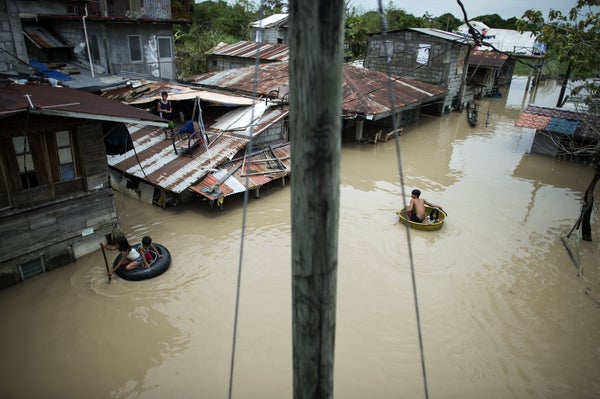
Climate change is the biggest threat to the planet, the World Economic Forum said yesterday in a sweeping catalog of global risks.
The institution’s annual analysis of economic dangers worldwide named extreme weather, natural disasters, man-made environmental disasters, biodiversity loss and failure to adapt to climate change as the chief perils to society.
Of all the risks to the globe, “it is in relation to the environment that the world is most clearly sleepwalking into catastrophe,” the WEF said in its Global Risks Report. “The results of climate inaction are becoming increasingly clear.”
On supporting science journalism
If you're enjoying this article, consider supporting our award-winning journalism by subscribing. By purchasing a subscription you are helping to ensure the future of impactful stories about the discoveries and ideas shaping our world today.
The report noted the Intergovernmental Panel on Climate Change’s October analysis that “bluntly said ... we have at most 12 years to make the drastic and unprecedented changes needed to prevent average global temperatures from rising” 1.5 degrees Celsius, roughly 2.7 degrees Fahrenheit. Limiting global temperature increase to that amount is the goal of the international Paris Agreement.
Meeting that goal “will require unprecedented action to drive decarbonization of agriculture, energy, industry and transport,” the WEF report said. However, “it appears increasingly unlikely that the world will meet even the 2 C upper limit identified by the Paris Climate Agreement.”
The Trump administration’s Fourth National Climate Assessment in November, meanwhile, said that “without significant reductions in emissions,” average global temperatures could rise 9 F by the turn of the century.
The risk report pointed to the “accelerating pace” of biodiversity loss as a particular concern. Species abundance is down 60 percent since 1970, it said. That affects the human food chain, health and socio-economic development, “with implications for well-being, productivity, and even regional security.”
Climate change as well is increasing strain on the global food system through changes in temperature, precipitation and extreme weather events, along with higher carbon emissions. The last four years have been the hottest on record, it said.
Sea-level rise is another peril. An estimated 800 million people in more than 570 coastal cities are vulnerable to oceans rising 1.6 feet by 2050.
Higher waters are already hitting home in the United States, the report said. Cities like Norfolk, Va.; Baltimore; Charleston, S.C.; and Miami experience flooding on sunny days due to rising sea levels. Rising water threatens roads, railways, ports, sanitation systems, tourism, agriculture, power plants and underground cables that connect the internet.
That puts pressure on cities as they decide where to put housing, it noted.
“As sea levels rise and urban vulnerabilities increase, the urgency of the need to respond to these changes is going to intensify,” the report said. “Beyond adaptation measures, addressing urban vulnerability to sea-level rise will require households, businesses and governments to avoid exacerbating dangers. There is little point putting new flood defences in place, for example, if existing defences are undermined through continued development of homes and businesses in coastal areas and on floodplains.”
Reprinted from Climatewire with permission from E&E News. E&E provides daily coverage of essential energy and environmental news at www.eenews.net.