
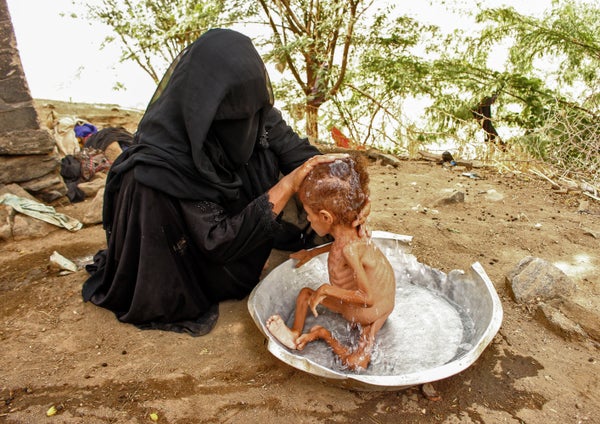
Droughts linked to climate change are going to hit vulnerable populations the hardest, especially communities in war-torn countries such as Yemen and South Sudan, according to a new study.
The study published yesterday in the Proceedings of the National Academy of Sciences said children in developing countries will be particularly at risk. It found that increased climate shocks could slow or even reverse years of progress in lowering rates of stunting caused by poor childhood nutrition.
About 1 in 9 people are currently undernourished worldwide, and poor nutrition is to blame for nearly half of the deaths of children younger than 5. This issue is expected to get worse as temperatures rise and droughts become more frequent due to climate change. Lead author Matthew Cooper, a doctoral student at the University of Maryland, said that these children will suffer despite having not contributed to climate change themselves.
On supporting science journalism
If you're enjoying this article, consider supporting our award-winning journalism by subscribing. By purchasing a subscription you are helping to ensure the future of impactful stories about the discoveries and ideas shaping our world today.
“This is a grave injustice that needs to be addressed,” he said in a press release.
The study used observations of more than 580,000 children from 53 countries and compared them to satellite data showing extreme differences in precipitation since 1990. The places found to be most vulnerable to drought included Chad, Eritrea, Sudan, South Sudan, Somalia and Yemen.
Cooper said a number of factors could help children become more resilient to droughts. Those include planting nutritionally diverse crops, increasing imports, improving irrigation and conducting good governance. Study co-author and University of Maryland research professor Molly Brown said that planting diverse crops would not only help during a drought but would also provide families with more to eat when things go well.
“There’s a lot of different approaches that could support children in times of drought,” Brown said.
Cooper said this information could help the U.N. Food and Agriculture Organization or the World Health Organization identify where to target aid. It could also help nongovernmental organizations and other groups work to advocate for nutritionally diverse farming methods in those countries.
Brown said in a perfect world there shouldn’t be a relationship between rainfall and child nutritional outcomes.
“It’s really a travesty,” she said. “No one is protecting the health and well-being of children in these agricultural communities.”
The study was released days after an alarming U.N. report found climate change poses a threat to global food security. The report called for dramatic changes in land use and changes in food production and distribution (Climatewire, Aug. 8).
Reprinted from Climatewire with permission from E&E News. E&E provides daily coverage of essential energy and environmental news at www.eenews.net.
