
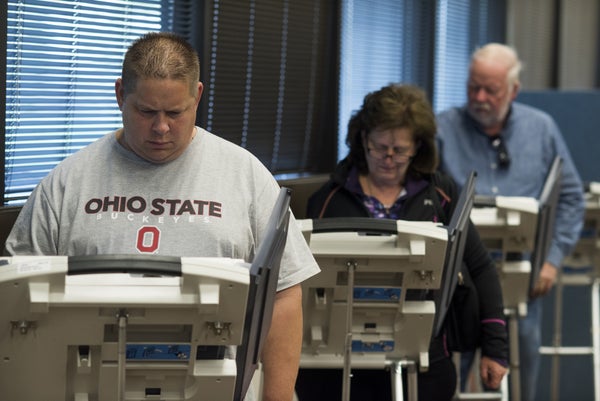
This year’s election faced an unprecedented kink: hacking. Wikileaks published hacked emails from Hillary Clinton campaign chairman John Podesta, for example, and Russian hackers were accused of compromising state election systems. Now some wonder whether hackers targeted the actual Nov. 8 vote results, shifting them in favor of Donald Trump in swing states where the vote was expected to be close.
New York Magazinereported Tuesday that experts were urging the Clinton campaign to challenge the results in Wisconsin, Michigan and Pennsylvania. The report, which cited an unnamed source, said a group including a computer scientist and a voting rights attorney had raised questions as to whether the election results in these states could have been hacked. Group members reportedly discussed their findings in a conference call with Clinton campaign staff last Thursday. Clinton’s camp has until this Friday to call for a Wisconsin recount, until Monday in Pennsylvania, and until next Wednesday in Michigan, the report notes. It also says that Clinton would only be able to claim a victory should all three of these states overturn their results, which would take Pennsylvania’s 20 electoral votes and Wisconsin’s 10 away from Donald Trump’s 290. Clinton would also have to tack on Michigan’s 16 electoral votes, which have unofficially been assigned to Trump but have yet to be finalized, to clinch the victory. After the Nov. 8 tallies, Clinton lags Trump by 58 electoral votes.
But a number of experts contend that the New York Magazine piece contains some incorrect numbers.
On supporting science journalism
If you're enjoying this article, consider supporting our award-winning journalism by subscribing. By purchasing a subscription you are helping to ensure the future of impactful stories about the discoveries and ideas shaping our world today.
The article says that “Clinton received 7 percent fewer votes in counties that relied on electronic voting machines compared with counties that used optical scanners and paper ballots. Based on this statistical analysis, Clinton may have been denied as many as 30,000 votes; she lost Wisconsin by 27,000.” However, Nate Silver, founder and editor-in-chief of the highly regarded, statistics-driven news site FiveThirtyEight, tweeted a quick analysis, claiming that this statement did not survive what Silver called a “basic sanity check.” He said the numbers in the article did not necessarily prove that Clinton would have won Wisconsin, according to his own model.
J. Alex Halderman, who directs the University of Michigan Center for Computer Security and Society and was among the experts mentioned in the New York Magazine report, also responded to and took issue with parts of the story hours after it was published, writing in a blog post: “Were this year’s deviations from pre-election polls the results of a cyberattack? Probably not. I believe the most likely explanation is that the polls were systematically wrong.” However, Halderman said the possibility of a cyberattack was still present, with the history of email and database hackings earlier in the election. Plus, plenty of papers Halderman cites have found security holes in American voting machines. His blog post highlighted that “the only way to know whether a cyber attack changed the result is to closely examine the available physical evidence”—the actual paper ballots. And the only way such an examination could happen would be if the Clinton team was to successfully petition the states for recounts this week.
In the past week, many voters have phoned the Justice Department asking for a recount based on a widely shared fake Facebook post. Others feel that past events, such as hacks that some have blamed on the Russian government, are reason enough to call for a congressional investigation, political journalist David Corn wrote in Mother Jones.
“If a foreign government has mucked about and undercut a presidential election, how can Americans be secure about the foundation of the nation and trust their own government? They need to know specifically what intervention occurred, what was investigated (and whether those investigations were conducted well), and what steps are being taken to prevent further intrusions,” Corn wrote.
Still, many other experts have already effectively dismissed the possibility that the election results themselves were rigged by hackers, and emphasized that the Clinton-favoring polls could have simply been wrong. “Trump performed particularly well, both compared to Mitt Romney in 2012 and to the 2016 polls, in many of the most Republican states in the nation (North Dakota, West Virginia, and Wyoming),” Columbia University statistics and political science professor Andrew Gelman wrote recently in Slate. Gelman, whose article appeared almost simultaneously with the New York Magazine report, argued that citizens complaining about rigging only in close-call states where they had seen a possibility for a Clinton win—and not in every state—demonstrated to him that “that the basis for these accusations is more perceived unfairness than actual statistics.” But he told Scientific American in a telephone interview Wednesday: “I think in general that random [vote] audits would be a good idea.”
Many experts agree that cybersecurity will be a quickly rising concern in future elections and that more safeguards, such as improved systems transparency and better auditing, will be needed to combat potential threats. “Officials need to begin preparing soon to make sure all of these improvements are ready before the next big election,” Halderman wrote.