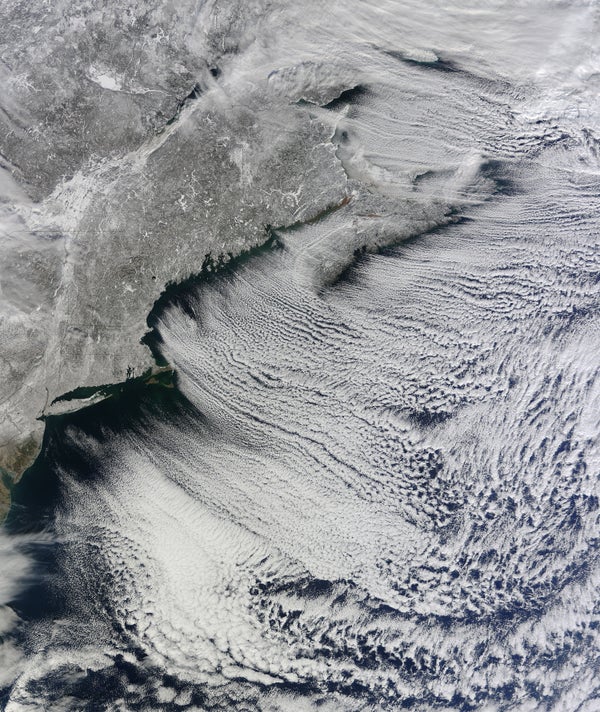
"Cloud streets" feather North America's storm-lashed eastern coast
NASA's Terra satellite caught this true-color picture on January 24 in a moment of clear weather between two major snowstorms that hit North America's eastern coast.
Jeff Schmaltz, MODIS Land Rapid Response Team, NASA GSFC
Join Our Community of Science Lovers!
On supporting science journalism
If you're enjoying this article, consider supporting our award-winning journalism by subscribing. By purchasing a subscription you are helping to ensure the future of impactful stories about the discoveries and ideas shaping our world today.
NASA's Terra satellite caught this true-color picture on January 24 in a moment of clear weather between two major snowstorms that hit North America's eastern coast. The neatly combed rows of clouds that cover the Atlantic Ocean are called cloud streets. They were formed when cold wind from the west blew over the warmer air above the ocean, creating parallel cylinders of rotating air. Clouds condensed where the air rotated upward.
The day Terra took this picture wind speeds of 100 kilometers per hour were recorded across Newfoundland and temperatures of –28 degrees Celsius were recorded in Quebec City, according to NASA. The next day, a storm brought 25 to 38 centimeters of fresh snow to New England.
–Francie Diep
It’s Time to Stand Up for Science
If you enjoyed this article, I’d like to ask for your support. Scientific American has served as an advocate for science and industry for 180 years, and right now may be the most critical moment in that two-century history.
SciAm always educates and delights me, and inspires a sense of awe for our vast, beautiful universe. I hope it does that for you, too.
If you subscribe to Scientific American, you help ensure that our coverage is centered on meaningful research and discovery; that we have the resources to report on the decisions that threaten labs across the U.S.; and that we support both budding and working scientists at a time when the value of science itself too often goes unrecognized.