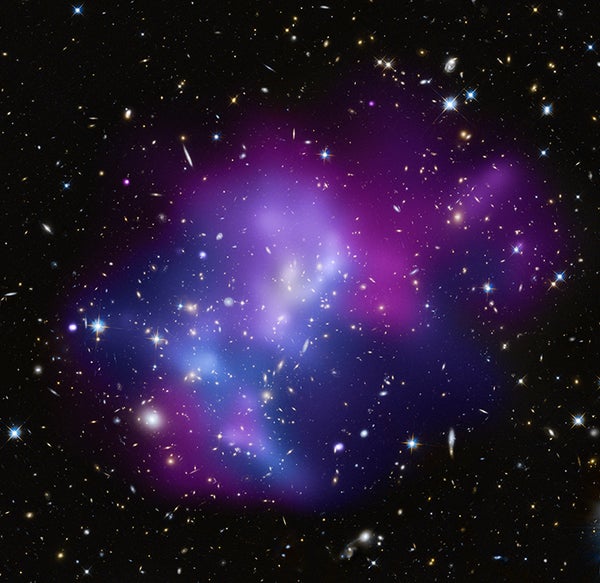
Five billion light-years away lies MACS J0717, a system of unprecedented collisions. This image, a composite of x-ray (blue, violet) and optical (cyan, yellow) wavelengths from multiple telescopes, captures the first documented merger involving four galaxy clusters, each of which is a massive gravitationally bound grouping of galaxies.
NASA, ESA, CXC, C. Ma, H. Ebeling, and E. Barrett (University of Hawaii/IfA), et al., and STScI
Join Our Community of Science Lovers!
On supporting science journalism
If you're enjoying this article, consider supporting our award-winning journalism by subscribing. By purchasing a subscription you are helping to ensure the future of impactful stories about the discoveries and ideas shaping our world today.
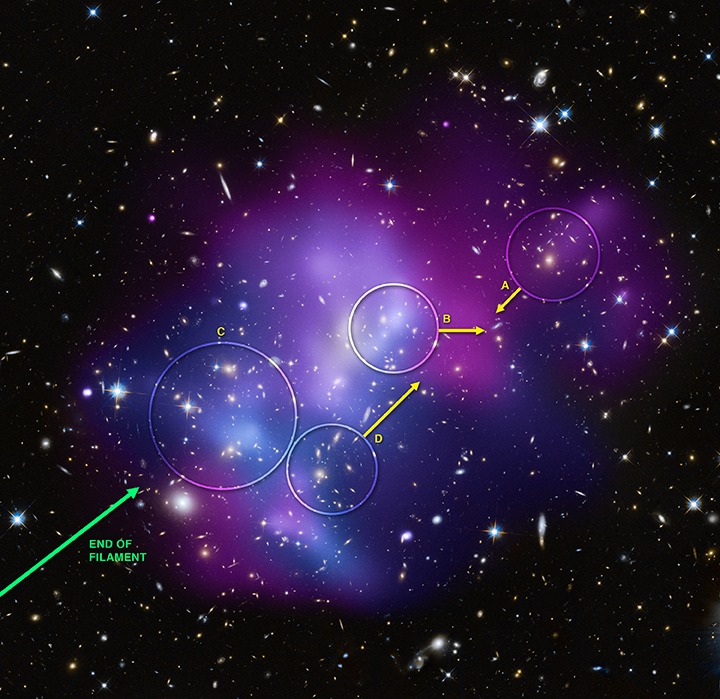
Five billion light-years away lies MACS J0717, a system of unprecedented collisions. This image, a composite of x-ray (blue, violet) and optical (cyan, yellow) wavelengths from multiple telescopes, captures the first documented merger involving four galaxy clusters, each of which is a massive gravitationally bound grouping of galaxies. (This labeled version shows the location of the individual clusters and the direction of motion for the speediest among them.) Such mergers are violent events: one of the clusters in MACS J0717 is racing through the system at approximately 3,000 kilometers (2,000 miles) per second. The entire structure is several million light-years across—for comparison, our Milky Way Galaxy is approximately 100,000 light-years in diameter.
It’s Time to Stand Up for Science
If you enjoyed this article, I’d like to ask for your support. Scientific American has served as an advocate for science and industry for 180 years, and right now may be the most critical moment in that two-century history.
SciAm always educates and delights me, and inspires a sense of awe for our vast, beautiful universe. I hope it does that for you, too.
If you subscribe to Scientific American, you help ensure that our coverage is centered on meaningful research and discovery; that we have the resources to report on the decisions that threaten labs across the U.S.; and that we support both budding and working scientists at a time when the value of science itself too often goes unrecognized.