
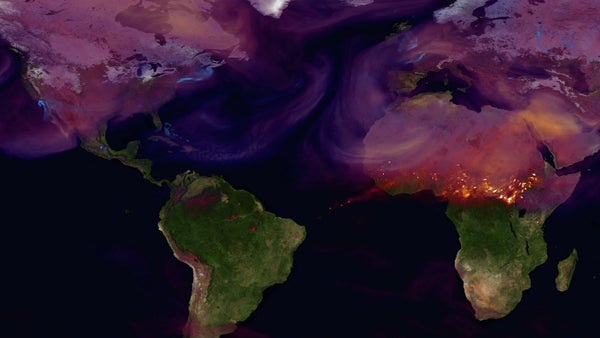
Global carbon emissions reached an all-time high in 2018, an extraordinary watermark in Earth’s history that underscores the need for faster and stronger action to address accelerating climate change, according to dozens of scientists.
A report released yesterday by a consortium of researchers known as the Global Carbon Project finds that global carbon dioxide emissions from burning fossil fuels are likely to have increased by about 2.7 percent in 2018, after a 1.6 percent increase in 2017.
The rise comes after a three-year period in which emissions remained mostly flat—providing hope to some climate activists that global carbon emissions had reached their peak. The increases in 2017 and 2018 seem to suggest otherwise.
On supporting science journalism
If you're enjoying this article, consider supporting our award-winning journalism by subscribing. By purchasing a subscription you are helping to ensure the future of impactful stories about the discoveries and ideas shaping our world today.
The scientists project that fossil-fuel-related carbon dioxide emissions will hit a record high of 37.1 billion metric tons by the end of this year. And they estimate that total carbon dioxide concentrations in the atmosphere will also hit their highest level ever, at 407 parts per million—about 45 percent higher than their preindustrial levels.
“[Current] energy and climate policies are not sufficient to overcome the growth in economic activity or energy-use growth,” said Glen Peters, research director at the Center for International Climate Research in Norway and a co-author of the new report. “So there’s no other alternative but to ramp up policies, basically, otherwise emissions will keep rising.”
The projections come during a season of urgent international discussions about the action required to meet the targets of the Paris climate agreement.
In October, the Intergovernmental Panel on Climate Change released a special report on the action that would be required to keep global temperatures within a 1.5 degrees Celsius target. The report noted that global carbon emissions would need to fall 50 percent by 2030 and reach net zero by 2050. The rate at which nations would need to reduce their emissions each year in order to reach those targets becomes steeper, and less attainable, every year that emissions continue to rise.
Last month, the United Nations released a separate report on the “emissions gap,” or the mismatch between the Paris climate targets and the actions nations are actually taking to reach them.
It confirms that the climate action pledged by nations is “inadequate to bridge the emissions gap” and that if actions are not strengthened before 2030, the 1.5 C target will slip out of reach. Overall, it suggests that current Paris commitments would need to be tripled to reach a 2 C target and increased fivefold to reach the 1.5 C target.
This week and next, nations are meeting in Poland to negotiate a set of rules for the Paris climate agreement, which will govern how individual countries’ pledges are reported and enforced. The news about emissions reaching historic levels casts new urgency on the need to finalize the rulebook and begin strengthening the Paris commitments.
The global challenge
For the time being, the world appears to be settling into an average emissions growth rate of about 1 percent per year, Peters noted, although it varies from year to year. The past two years have seen slightly higher growth, and 2014 through 2016 saw less.
The report attributes the three-year pause largely to declines in coal use in China, which was temporarily investing less into energy-intensive construction projects, and the United States, thanks to a shift in natural gas, solar and wind power. Now those days are over. Emissions are on the rise with coal use, including a 4.5 percent increase in coal in China and a 7.1 percent increase in India.
U.S. emissions are projected to grow by about 2.5 percent in 2018, despite an otherwise downward trend—and continued declines for coal—in large part due to growth in oil and natural gas and a year marked by unusually severe winter and summer weather. That seems to have spiked emissions from heat and electricity.
In a broader sense, reversing the upward trend in global emissions comes down to two major challenges, Peters suggested—strengthening reductions in places where emissions are already declining, and reducing growth in places where emissions are still climbing. In nations where emissions are already trending downward—the United States, for one—they must find ways to reduce their emissions even faster. That can be done by displacing fossil fuels with clean energy, electric vehicles and so on.
In nations where emissions are still rising, often in response to economic growth and improved living standards, the challenges are often greater. Even in countries with high rates of deployment for wind and solar, such as India and China, growing demand for energy is still eclipsing growth in renewables.
Worldwide, renewable energy continues to see remarkable growth. The report notes that renewables are on track to produce half the world’s electricity by 2030. The problem is that the growth is not yet enough to keep track with global energy demand and the timeline on which greenhouse gas reductions are needed to meet the Paris goals.
Still, experts say there’s room for optimism. In a comment published yesterday in Nature, dozens of co-authors—led by Christiana Figueres, a former executive secretary of the U.N. Framework Convention on Climate Change—suggested that decarbonizing the global economy by 2050 may still be within reach.
The growth in renewables and other low-carbon technologies is encouraging, they note, and some nations are already strengthening their Paris pledges. What’s needed now is continued policy growth that will “ensure that the exponential curve of solutions outpaces that of climate impacts, and drives net emissions to zero by 2050,” they write.
Speed continues to be the critical factor, Peters noted.
“You could say every year of delay means we’re facing higher temperatures in the future or more negative emissions in the future, or both,” he said.
Reprinted from Climatewire with permission from E&E News. E&E provides daily coverage of essential energy and environmental news at www.eenews.net.