
Major electricity providers and some government officials in West Virginia, the state leading the charge against federal climate change regulations, want to use carbon trading to meet their greenhouse gas reduction targets, according to public records obtained by ClimateWire.
More than a dozen documents reveal for the first time that despite political pushback against U.S. EPA's Clean Power Plan, key interests in the state are searching for ways to comply in case legal challenges fail.
West Virginia's politicians are among the loudest critics of the climate regulation. The state attorney general, Patrick Morrisey (R), is leading a 24-state lawsuit to kill it, and the state Legislature last year passed a law that limits the kind of plan that the state's environment agency, the Department of Environmental Protection (DEP), can write to meet federal goals.
On supporting science journalism
If you're enjoying this article, consider supporting our award-winning journalism by subscribing. By purchasing a subscription you are helping to ensure the future of impactful stories about the discoveries and ideas shaping our world today.
But comments filed to the agency show that important players in West Virginia—including utilities and a member of the governor's Cabinet—want the flexibility to use carbon trading to comply. They say trading is the cheapest option for companies and consumers, and argue that they cannot meet EPA's goals under the current state law.
'We just can't get there'
The missives come as West Virginia, many other states and numerous trade groups are fighting in court to stall or nix the Clean Power Plan. They show how companies affected by the rule are encouraging entrenched opponents of EPA to make backup plans to comply in case legal attacks don't succeed.
"If the [Clean Power Plan] is implemented in West Virginia, credits or allowances will be required for coal plants to continue to operate," said Longview Power LLC, which boasts it owns the cleanest coal plant in the state, during a December presentation.
Longview Power CEO Jeff Keffer said in an interview that feedback the environment agency has received from power companies likely reflects broad agreement from the power sector that the state can't meet EPA's targets without legislative changes.
"The first step DEP has is to develop a feasibility study," said Keffer. "I suspect that feasibility study will highlight the conflicts between the preparation of a [state compliance plan] and that state statute and the limitations that they have enacted."
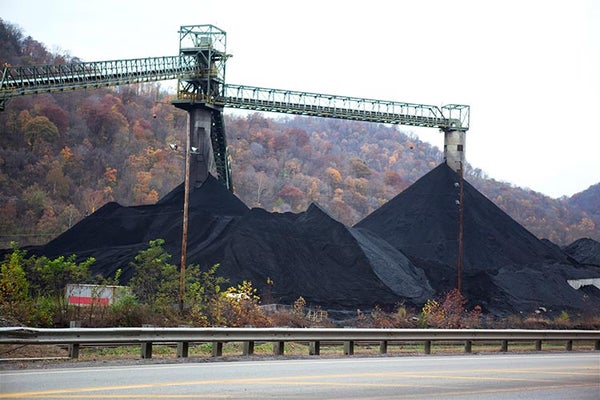
EPA requires states to cut their power plant carbon dioxide emissions rates by varying amounts by 2030. West Virginia—which relies almost entirely on coal power and also depends on mining to drive the state's economy—must make a reduction of 37 percent.
EPA's rule allows states to ramp up renewable energy and natural gas usage to reach goals. It also lays out guidelines for carbon trading, which lets power generators buy allowances or credits from cleaner electricity sources to meet required CO2 levels. Power companies in many states are looking to use carbon trading to comply (ClimateWire, Jan. 19).
But opponents, including Morrisey and members of West Virginia's Legislature who crafted H.B. 2004, argue that EPA legally can only require specific changes to make coal plants run more efficiently. The law restricts West Virginia's environment agency to writing a carbon-cutting plan based on efficiency improvements that can be made at plants. It calls on DEP to analyze the Clean Power Plan and tell legislators whether the standards are feasible in light of the law's restrictions. DEP finished collecting comments late last month to conduct that analysis.
Inspired by the American Legislative Exchange Council, the law also requires the Legislature to approve any plan before state officials send it to EPA (ClimateWire, March 5, 2015).
Asked if West Virginia's coal units can meet EPA's carbon targets under the state law, DEP senior policy adviser and counsel Thomas Clarke said, "We just can't get there."
"Other than capturing carbon, which has yet to be shown to be feasible ... there's really not anything else you can do at the unit," Clarke said.
West Virginia's power companies agreed. Utility American Electric Power said "the obvious conclusion" is that developing a state plan to meet EPA standards is "not feasible given the constraints imposed by H.B. 2004."
"The legislation limits West Virginia's ability to craft an implementation plan that would meet the targets in the Clean Power Plan and be approved by the EPA," AEP spokeswoman Tammy Ridout said in an emailed statement.
"The state could then be subjected to a federal plan, which if finalized as proposed, would take a 'one size fits all' approach that will not be tailored to the unique infrastructure, economic needs or policy objectives of individual states."
Opponents call Clean Power Plan 'illegal'
Power company Dominion, which operates three coal-fired units subject to the Clean Power Plan in West Virginia, recommended that the state develop a carbon-cutting plan that uses interstate trading. Officials argued that there are "very limited economically viable options for achieving the CPP standards" otherwise.
And "in general, market-based approaches are the most cost effective if properly constructed," said holding company FirstEnergy Corp. on behalf of its subsidiaries Monongahela Power Co., Potomac Edison and Allegheny Energy Service Corp.
FirstEnergy spokeswoman Jennifer Young said in an emailed statement, "responding to West Virginia's questions regarding West Virginia House Bill 2004 was the first step in what will likely be a lengthy process and conversation about the state's implementation plan."
West Virginia's attorney general interpreted the comments to DEP as evidence that the state can't comply with EPA's rule without changing state laws and reaching beyond the coal plant "fence line," allowing for carbon trading or relying on cleaner sources of power.
Morrisey said in an emailed statement that the comments to DEP "further demonstrate the need for an immediate stay of the illegal Power Plan, a plan already causing real and irreversible changes on the ground in the states."
State Sen. Gregory Boso (R), chairman of the West Virginia Senate's Energy, Industry and Mining Committee, did not respond to requests for comment in time for publication, and neither did other members of the West Virginia Legislature, including co-sponsors of H.B. 2004.
Even mine workers union calls to study trading
Despite current law, Gov. Earl Ray Tomblin (D) is requiring that the state write a blueprint to cut emissions, rather than be forced to comply with a federal version (ClimateWire, Oct. 28, 2015).
To retain West Virginia's role as an electricity exporter to other states, to limit job losses and to keep power prices low for customers, the state should "maximize whatever flexibility is offered under the Clean Power Plan," stated comments from Commerce Department Secretary J. Keith Burdette, who works under the governor. That flexibility should include allowing utilities to purchase allowances in a carbon trading system, Burdette wrote.
The United Mine Workers of America (UMWA), which is also suing EPA, said it is confident that legal challenges will halt the rule.
The union doubts the merits of interstate trading but nonetheless called for more comprehensive analysis into various compliance approaches "to determine the best course for West Virginia in the event that it must comply with the final rule."
UMWA President Cecil Roberts wants the state to seek a two-year extension to submit a plan, which means filing a status report to EPA in September.
"This would allow WV DEP to proceed with stakeholder meetings in the meantime to assess the merits of alternative compliance pathways," Roberts wrote to the state.
Greens blast 'war on coal' rhetoric
Meanwhile, environmental advocates with the Sierra Club's West Virginia Chapter interpreted the law differently than both the power companies and DEP. In their comments, activists said that while H.B. 2004 requires "unit-specific" standards for coal plants, that does not prohibit carbon emissions trading.
"We recommend that DEP conclude that compliance is technically feasible, because it is," the Sierra Club said.
The West Virginia Chapter's Energy Committee chairman, Jim Kotcon, acknowledged in an interview that other legal experts might disagree.
"If read in its most restrictive way, then DEP is probably unable to construct a [state plan] that would comply with EPA's rule," Kotcon said.
"I certainly do not want to discount the political influence of our utilities and electric generating industries with the Legislature—they far exceed my limited influence," Kotcon said. "At the same time, so many of our West Virginia legislators have been so locked onto the friends of coal and the 'EPA war on coal' rhetoric that it is going to be interesting to see if they can backpedal enough to actually vote for a [state implementation plan]."
But DEP senior policy adviser and counsel Clarke said in a December interview that the law's language may leave it open to changes down the road.
H.B. 2004 "asks us to analyze the need for legislative or other changes to state law. And so what we may do is tell the Legislature, 'Gee, if you want to submit a plan, some of these things that you've put in House Bill 2004 that limit what we can do in a state plan need to come out of state law,'" Clarke said.
Reprinted from Climatewire with permission from Environment & Energy Publishing, LLC. www.eenews.net, 202-628-6500