
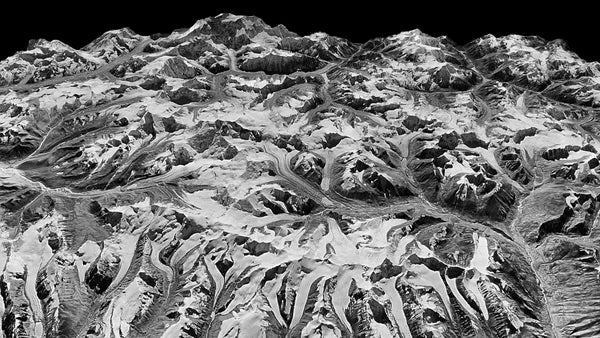
During the height of the Cold War, U.S. spy satellites collected secret images as they circled the Earth. Today, those images are helping scientists track the effects of climate change.
A new analysis of declassified spy imagery, published yesterday in Science Advances, has revealed some alarming trends in one of the world’s iciest regions. Glaciers in the Himalayas are melting twice as fast now as they were before 2000. And scientists suggest that rising temperatures are likely to blame.
Led by graduate student Josh Maurer of Columbia University, the researchers analyzed data collected by U.S. spy satellite KH-9 Hexagon during the 1970s and 1980s, as well as additional satellite imagery collected through the 2000s. They used the data to investigate changes in 650 large glaciers throughout the Himalayas.
On supporting science journalism
If you're enjoying this article, consider supporting our award-winning journalism by subscribing. By purchasing a subscription you are helping to ensure the future of impactful stories about the discoveries and ideas shaping our world today.
The data suggests that the glaciers have experienced significant ice loss over the past four decades, with the melt rate speeding up substantially in recent years. From 2000 to 2016, losses were approximately double what they were between 1975 and 2000.
While the losses varied somewhat from one location to the next, the trends were broadly consistent across the entire 1,200-mile strip of the Himalayas the study examined. According to the researchers, that suggests that the accelerating ice loss must be driven by some factor that’s broadly affecting the Himalayan region as a whole.
The researchers say that rules out changes in precipitation and changes in air pollution—factors that haven’t varied in the same ways across the entire study region. Instead, they say regional warming is probably the culprit.
According to additional analysis, the amount of melting the satellite imagery exposed would require anywhere from 0.4 to 1.4 degrees Celsius of warming in the 2000s, relative to the previous decades. In fact, local weather stations recorded about 1 C of warming between 2000 and 2016. That means the rising temperatures are consistent with the observed melting.
The findings broadly support other recent studies of ice loss in the Himalayas.
The International Centre for Integrated Mountain Development published a major report in February on glaciers in the Hindu Kush Himalayas—a region commonly referred to as the world’s “Third Pole” because it contains so much ice. Drawing on recent research and the conclusions of climate models, the report warned that the region’s glaciers could lose more than a third of their volume by the end of the century, even if world nations meet the climate targets outlined in the Paris Agreement (Climatewire, Feb. 4).
It’s not just the Himalayas that are losing their mountain ice. The new study points out, for instance, that many glaciers in the European Alps have experienced even stronger warming trends and more rapid ice loss over the past few decades.
These trends are important to monitor for a number of reasons. On a regional level, mountain glaciers are a key source of fresh water for both natural ecosystems and nearby human communities, helping to feed mountain streams as they melt during the warm summer months. Many experts have warned that as these glaciers shrink, they could alter the local hydrology and disrupt nearby water supplies.
And on a global level, melting mountain glaciers are also a significant contributor to sea-level rise. While ice loss from the colossal Greenland and Antarctic ice sheets tends to inspire the greatest concern when it comes to global sea levels, research suggests that mountain glaciers elsewhere around the world account for about a third of all the sea-level rise that’s occurred in the past 60 years (Climatewire, April 9).
Reprinted from Climatewire with permission from E&E News. E&E provides daily coverage of essential energy and environmental news atwww.eenews.net.