March 26, 2010
1 min read
 Add Us On GoogleAdd SciAm
Comet-kazi: Sun-observing spacecraft spots a comet's demise
The Solar and Heliospheric Observatory (SOHO), launched in 1995 by NASA and the European Space Agency to study the sun and its environs, has delivered an auxiliary benefit—discovering more comets than any other mission in history.
On supporting science journalism
If you're enjoying this article, consider supporting our award-winning journalism by subscribing. By purchasing a subscription you are helping to ensure the future of impactful stories about the discoveries and ideas shaping our world today.
The Solar and Heliospheric Observatory (SOHO), launched in 1995 by NASA and the European Space Agency to study the sun and its environs, has delivered an auxiliary benefit—discovering more comets than any other mission in history. Most of the more than 1,500 comets SOHO has spotted are sun-grazing fragments of larger bodies, which themselves may have split off a common progenitor relatively recently, less than 2,000 years ago. That progenitor would have had an orbit that brought it from the outer solar system and past the sun only every several hundred years.
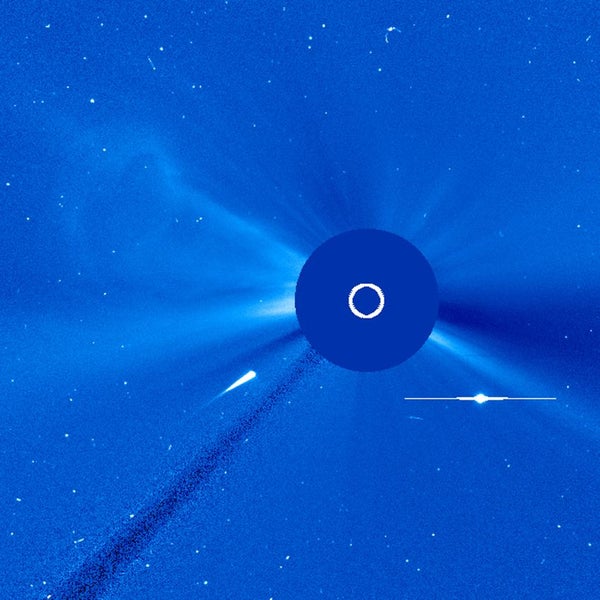
On March 12, SOHO spied a bright comet, likely from that same sun-grazing lineage, in its final hours as it streaked toward a fatal encounter with the sun. The inbound comet is visible below and to the left of the sun in this SOHO image. (The blinding disk of the sun itself is blotted out by an instrument called a coronagraph, which allows researchers to observe the solar atmosphere.) The bright point within the horizontal streak just below the sun is the planet Mercury.
It’s Time to Stand Up for Science
If you enjoyed this article, I’d like to ask for your support. Scientific American has served as an advocate for science and industry for 180 years, and right now may be the most critical moment in that two-century history.
SciAm always educates and delights me, and inspires a sense of awe for our vast, beautiful universe. I hope it does that for you, too.
If you subscribe to Scientific American, you help ensure that our coverage is centered on meaningful research and discovery; that we have the resources to report on the decisions that threaten labs across the U.S.; and that we support both budding and working scientists at a time when the value of science itself too often goes unrecognized.
In return, you get essential news, captivating podcasts, brilliant infographics, can't-miss newsletters, must-watch videos, challenging games, and the science world's best writing and reporting. You can even gift someone a subscription.
There has never been a more important time for us to stand up and show why science matters. I hope you’ll support us in that mission.