
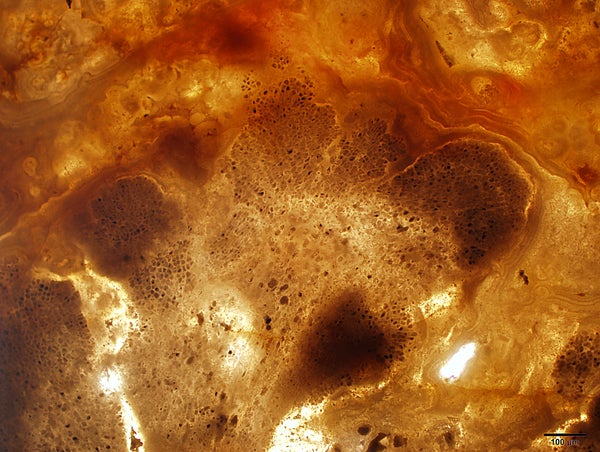
It was around 1.6 billion years ago that a community of small, bright red, plantlike life-forms, flitting around in a shallow pool of prehistoric water, were etched into stone until the end of time. Or at least until a team of Swedish researchers chipped their fossilized remnants out of a sedimentary rock formation in central India.
Research published this week in PLoS Biology suggests this collection of ancient, newly analyzed fossils—unearthed a few years back—are in all likelihood red algae. If that proves true, it would imply that complex, multicellular life evolved a lot earlier than previously thought—and that the evolutionary family tree of life on Earth might need a major pruning.
Earth’s first traces of life probably showed up around 3.5 billion years ago, a billion years or so after our planet formed. Just when these simple, single-celled organisms—classified as “prokaryotes” due to their lack of a nucleus—evolved into multicellular, nucleated forms called “eukaryotes” is a matter of debate. Alga, a eukaryote, is thought to be one of the oldest forms of complex life. And given that previous fossil finds had dated red algae back just 1.2 billion years, the new discovery could reset the evolutionary time line by nearly half a billion years.
On supporting science journalism
If you're enjoying this article, consider supporting our award-winning journalism by subscribing. By purchasing a subscription you are helping to ensure the future of impactful stories about the discoveries and ideas shaping our world today.
The apparent red alga was found embedded in fossilized sheets of cyanobacteria, widely believed to be the first oxygen-producing life-forms to have arisen and a precursor all to algae and plants. (Although not all algae are considered “plants” per current classification, they are all considered plantlike because they use photosynthesis to produce energy). By dissolving surrounding rock with acetic acid—a common method used in excavating fossils—the new paper’s authors unearthed what appear to be two forms of red alga: a tubular strain resembling a segmented pool noodle and a fleshier variety composed of multilayered collections of cells.
The authors used a technique called synchrotron-based x-ray tomographic microscopy to construct a three-dimensional model of the fossils, and to identify internal cellular structures that the organisms probably used for energy production. Radioactive dating was used to confirm the fossils’ age. “The new fossils provide tangible evidence that advanced multicellularity, at least in plants, appeared much earlier than previously thought,” says Stefan Bengtson, senior author of the new paper and professor emeritus of paleozoology at the Swedish Museum of Natural History. “They suggest that the timing of early eukaryotes may have to be drastically revised.”
Without the presence of DNA—which does not hang around in samples so staggeringly old—it is impossible to confirm the new fossils are bygone red algae. Bengtson admits as much. But he also believes the fossils’ structures bear a strong resemblance to that of red alga.
Paul Strother, a Boston College biologist who studies the evolution of algae and plants, and who was not involved in the new research, is not sold. “If these are real…they still do not show any sort of cell differentiation. All the cells are basically the same, and these forms do not represent complex multicellularity,” he says.
University of Wisconsin–Eau Claire biology chair, Wilson Taylor, who was also uninvolved in the work, points out that even if the new samples are really algae, the search for the origins of complex life still has a long way to go. “If a red alga really had evolved by this time…this implies a prior period of eukaryotic evolution of some length,” he says. “How long before the 1.6-billion-year horizon eukaryotes arose, based on that early occurrence, is anyone's guess.” Taylor explains that eukaryotes—which comprise virtually all nonmicroscopic life on Earth—likely arose when one prokaryote engulfed another and found some symbiotic benefit that kept the relationship going. But how long it took this vital communion to take hold in the evolutionary process is unknown.
As Bengtson points out, whereas red algae are not a direct precursor to plants—that honor belongs to green algal ancestors—they do closely descend from one common ancestor of all plants on Earth today. Assuming the new findings are true, a major question now facing paleobotanists is why it took another billion years for larger, more complex organisms to flourish.
It was not until between 600 million and 500 million years ago that higher plants and animals began evolving. Submarine algae, bobbing amid blankets of microbes, gradually gave way to what we know as plants. Plants made their way to shore, shaping a new landscape that would come to include complex fungi and, eventually, terrestrial animals.
Bengtson hopes to further study early algal populations in order to better pinpoint where and when they arose, and why they lingered in the sea for so long. Although evolution’s tributaries will no doubt continue to be modified—some rerouted, others reset—scientists can assume they are closing in on an accurate lineage of life on Earth; and that our photosynthetic, oxygen-producing co-dwellers, on which our lives rely, have speckled the planet we call home for much of its existence.