
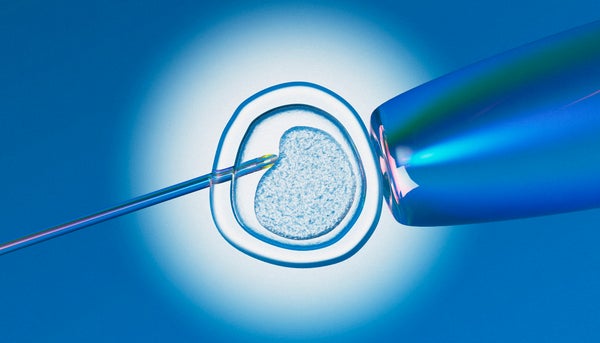
A House committee on Tuesday restored to pending legislation a ban on altering the genomes of human embryos intended for pregnancies, despite calls from some scientists to lift the ban and allow the Food and Drug Administration to review applications for new technologies.
Lifting the prohibition could have opened the door to clinical trials of babies being made with genetic material from three people or with genomes that had been changed in ways that would be passed on to future generations.
The ban has been attached to bills that fund the Food and Drug Administration in the form of an amendment, or rider, since December 2015. But last month, a subcommittee of the House Appropriations Committee dropped the ban from the legislation.
On supporting science journalism
If you're enjoying this article, consider supporting our award-winning journalism by subscribing. By purchasing a subscription you are helping to ensure the future of impactful stories about the discoveries and ideas shaping our world today.
At a hearing Tuesday, supporters of the ban framed it as a necessary barrier to prevent experiments like the one announced last year in which a Chinese scientist created the world’s first gene-edited babies with the technology CRISPR. The work drew worldwide condemnation for skirting ethical and regulatory guidelines and for using scientific tools that were not yet ready to be used in people.
“The ethics hadn’t caught up with the science, and… the science has not caught up with the science,” said Rep. Robert Aderholt (R-Ala.), who introduced the rider in 2015 and again at Tuesday’s hearing. He said that for now, genetically editing embryos had “too many unknowns, too many unintended consequences.”
The rider blocks the Food and Drug Administration from considering clinical trial applications “in which a human embryo is intentionally created or modified to include a heritable genetic modification.” Scientists and ethicists who advocated for dropping it argued that doing so would simply allow the FDA to review research requests, as it does any other innovative therapy.
Some Democratic lawmakers who had appeared supportive of dropping the ban earlier — and who had criticized the inclusion of the ban in 2015 without debate — said they felt it was time for Congress to debate the underlying ethical and scientific issues. But they said that should be done separately from the appropriations process.
The chairwoman of the committee, Democrat Nita Lowey of New York, said she “reluctantly supported” returning the ban to the bill. She acknowledged that editing embryonic DNA had some potential risks, but added that it could cure and prevent genetic disease.
“We have a moral obligation to allow advances in science so that fewer parents have to watch a child die,” she said.
Some scientists had called on Congress to modify the legislation to allow so-called three-parent embryos but maintain the ban on the direct editing of embryonic DNA. The three-parent technology, more precisely called mitochondrial replacement therapy, or MRT, has the potential to prevent severe diseases that result from abnormal mitochondria, energy-producing cellular structures. It involves transferring the nucleus of an unfertilized egg with defective mitochondria into one with healthy mitochondria and then fertilizing it via IVF. Because mitochondria have a small bit of their own DNA, the resulting embryo has genes from three people.
The technology is being studied in some countries, including Britain, as a way to halt the inheritance of genetic diseases that stem from the DNA in the mitochondria.
Rep. Sanford Bishop Jr. (D-Ga.), who chaired the subcommittee that approved the bill without the ban last month, said he wanted Congress to discuss allowing MRT, “but today is not that time, and this appropriations committee markup is not that place.” He supported adding the ban back to the bill.
The committee approved the amendment to reinsert the ban on a voice vote, but one Democrat who voted against it was Rep. Debbie Wasserman Schultz of Florida. She carries a variant of the BRCA2 gene that raises her risk of certain cancers (she was diagnosed with breast cancer in 2007) and said her children would have to get tested to see if they carried the mutation.
“If we ever have an opportunity when they have children or when they decide to have a family, to have research advanced to a point where you could have their genetic material, when combined with their partner, altered so that that mutation could be cut off in our family tree and that risk of death and massive health care implications could be eliminated, that’s incredibly important,” she said.
She added: “This is not ‘2001: A Space Odyssey’ or ‘1984’ or a mad scientist playing games with genetic material. There are real opportunities… to try to cut off the passing on of genetic mutations that can have dramatic life-altering implications.”
Republished with permission from STAT. This article originally appeared on June 4, 2019