
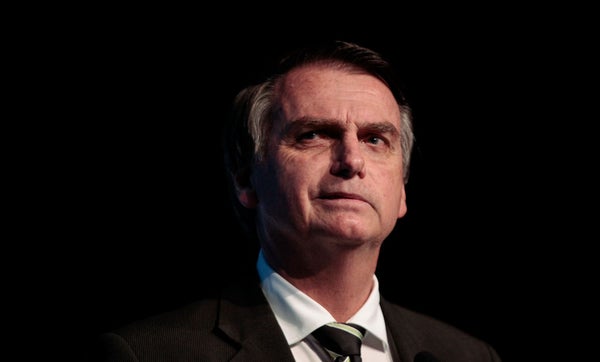
Brazil’s new president could spell disaster for the Amazon rainforest.
The country voted Sunday to elect Jair Bolsonaro, a far-right politician who has expressed no sympathy for the indigenous people who live in the Amazon or for their global environmental allies.
In invective-laced Twitter posts and speeches leading up to his victory, Bolsonaro, a former member of the Brazilian army, has proposed expelling international environmental groups, withdrawing from the Paris climate agreement, and opening the iconic rainforest to traffic and trade.
On supporting science journalism
If you're enjoying this article, consider supporting our award-winning journalism by subscribing. By purchasing a subscription you are helping to ensure the future of impactful stories about the discoveries and ideas shaping our world today.
That could threaten the country’s indigenous people, whom Bolsonaro has said should “either adapt or simply vanish.”
“The Bolsonaro victory is an utter catastrophe for the Brazilian Amazon rainforests and its indigenous and traditional peoples,” said Christian Poirier, program director for Amazon Watch.
Bolsonaro is expected to end the titling of territories for indigenous tribes, who have lived in the Amazon time immemorial and have a stake in seeing the land used sustainably and fighting illegal forestry and land seizure.
“This has drastic implications for the rights of indigenous and traditional peoples in the Amazon, for their ability to continue living their way of life and continuing to steward these forests for our collective benefit,” said Poirier.
Bolsonaro is against some of the policies that have helped Brazil make recent headway in combating deforestation. For example, he’s floated subsuming Brazil’s ministry of environment and the agencies that oversee conservation and law enforcement in the Amazon under the country’s agriculture ministry, which has ties to multinational agribusinesses.
He’s also taken a hostile view on preserving roadless areas. He proposed an 870-kilometer (541-mile) paved highway through protected forest, a move that critics say would invite more road construction and economic activity in the area.
Poirier worries the move could make indigenous people vulnerable to violence, especially if they resist the development of their lands.
Steve Schwartzman, who leads the Environmental Defense Fund’s work on tropical forests and economic incentives, called indigenous safety an “absolute first-level concern” given Bolsonaro’s stance on limiting their rights and his opposition to arms control.
“The land-grabbers and illegal loggers and criminal gangs that are operating in the Amazon are going to be even more of a threat to the indigenous communities,” Schwartzman predicted.
Bolsonaro last week backed off previous claims that he would follow President Trump’s lead and quit the Paris Agreement. But he’s left open the possibility that he could change his mind if the climate deal is seen to infringe on Brazilian sovereignty over indigenous lands. The deal does recognize the importance of indigenous rights in the context of the global response on climate change but doesn’t mandate any controls on domestic law.
Schwartzman said that Bolsonaro is referencing a “conspiracy theory” shared inside the Brazilian military that the deal would impose conditions on Brazil to remove indigenous territories from national control.
Bolsonaro may still opt to pull Brazil out of the deal under the mistaken impression that it will tie his government’s hands in the Amazon. If he does, he’d be following in the footsteps of Trump, who is said to have been swayed to leave the Paris accord because then-EPA Administrator Scott Pruitt and White House Counsel Don McGahn claimed that it could complicate plans to dismantle Obama-era domestic rules and regulations. Most sections of the agreement are not legally binding, and it includes no mechanism to contravene national law.
Schwartzman notes that Brazil, which played host to the 1992 Rio Earth Summit that produced the United Nations Framework Convention on Climate Change, has generally valued multilateral cooperation to combat warming.
It’s not clear what impact the rise of Bolsonaro might have on Brazil’s commitment under the Paris Agreement to cut greenhouse gas emissions 37 percent by 2025, in part because it doesn’t count emissions from deforestation. Bolsonaro is expected to be an ally of carbon-rich economic activity, including the country’s oil and gas industry.
“I think like President Trump he suffers from the illusion that unsustainable economic growth, including growth in the gas and oil sector, is all benefit and no cost,” said Schwartzman. “And that the transition to sustainability in the energy sector is all cost and no benefit, which is particularly unfortunate in Brazil’s case, because Brazil really has a lot of potential in the low-carbon economy.”
Often called the lungs of the planet, the Amazon is estimated to sequester upward of 2 billion metric tons of carbon dioxide each year.
That’s threatened by illegal logging. Brazil’s government estimates that 27,772 square kilometers of rainforest was illegally cleared in 2004. Government policies and local activism drove that number down to 4,571 square kilometers in 2012. Last year, illegal logging cleared 7,000 square kilometers.
Reprinted from Climatewire with permission from E&E News. E&E provides daily coverage of essential energy and environmental news at www.eenews.net.