Coronavirus Antibody Tests Have a Mathematical Pitfall

The accuracy of screening tests is highly dependent on the infection rate

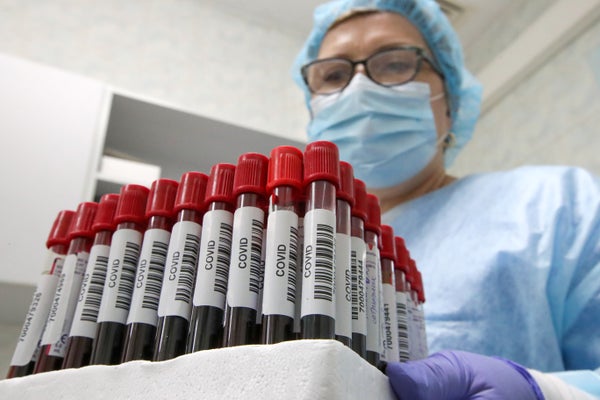
A healthcare worker holds vials of blood samples while performing lab tests which detect immunoglobulin class G (IgG) antibodies to SARS-CoV-2 virus at the Sklifosovsky Research Institute of Emergency Care in Moscow, Russia, on May 29, 2020.

Join Our Community of Science Lovers!

Scientists working to quell the COVID-19 pandemic have developed tests that detect antibodies in the blood of people who have previously been infected with the new coronavirus. These serology tests can provide important data on how COVID-19 is spreading through a population. There is also hope that the presence of certain antibodies may signify immunity to future infection—a possibility scientists are still investigating. Antibody tests do have potential shortcomings: they may detect ineffective antibodies, they do not indicate if an infection is still active, and they fail to detect infection if administered before antibodies develop. A new test's accuracy can also be difficult to determine because of a lack of data.

Still, such tests have been proposed as a way for individuals to find out if they have already been infected with the novel coronavirus. But a mathematical wrinkle makes these tests—and in fact, all screening tests—hard to interpret: even with a very accurate test, the fewer people in a population who have a condition, the more likely it is that an individual's positive result is wrong. If it is, people might think they have the antibodies (and thus may have immunity), when in fact they do not.

A positive screening test result for other diseases usually prompts follow-up testing to confirm a diagnosis. But for COVID-19 screening, such follow-up has been rare because testing resources are scarce or because other testing methods are prioritized for the sickest patients. Here's a look at the massive impact infection rates can have on the predictive value of these tests for individuals.


On supporting science journalism

If you're enjoying this article, consider supporting our award-winning journalism by subscribing. By purchasing a subscription you are helping to ensure the future of impactful stories about the discoveries and ideas shaping our world today.


Credit: Amanda Montañez

Read more about the coronavirus outbreak from Scientific American here. And read coverage from our international network of magazines here.

Sarah Lewin Frasier is a senior editor at Scientific American. She plans, assigns and edits the Advances section of the monthly magazine, as well as editing online news, and she launched Scientific American’s Games section in 2024. Before joining Scientific American in 2019, she chronicled humanity’s journey to the stars as associate editor at Space.com. (And even earlier, she was a print intern at Scientific American.) Frasier holds an A.B. in mathematics from Brown University and an M.A. in journalism from New York University’s Science, Health and Environmental Reporting Program. She enjoys musical theater and mathematical paper craft.

More by Sarah Lewin Frasier
Scientific American Magazine Vol 323 Issue 1This article was published with the title “False Positive Alarm” in Scientific American Magazine Vol. 323 No. 1 (), p. 12
doi:10.1038/scientificamerican0720-12

It’s Time to Stand Up for Science

If you enjoyed this article, I’d like to ask for your support. Scientific American has served as an advocate for science and industry for 180 years, and right now may be the most critical moment in that two-century history.

I’ve been a Scientific American subscriber since I was 12 years old, and it helped shape the way I look at the world. SciAm always educates and delights me, and inspires a sense of awe for our vast, beautiful universe. I hope it does that for you, too.

If you subscribe to Scientific American, you help ensure that our coverage is centered on meaningful research and discovery; that we have the resources to report on the decisions that threaten labs across the U.S.; and that we support both budding and working scientists at a time when the value of science itself too often goes unrecognized.

In return, you get essential news, captivating podcasts, brilliant infographics, can't-miss newsletters, must-watch videos, challenging games, and the science world's best writing and reporting. You can even gift someone a subscription.

There has never been a more important time for us to stand up and show why science matters. I hope you’ll support us in that mission.

Thank you,

David M. Ewalt, Editor in Chief, Scientific American

Subscribe