
The coronavirus outbreak has reached the Arctic—and is imperilling a massive international scientific project, after a team member tested positive for the virus.
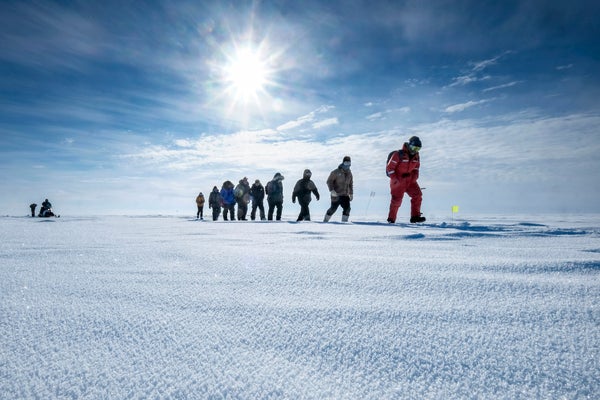
The mission, called MOSAiC, is operating from the German research vessel Polarstern, which has been intentionally frozen in Arctic sea ice since last October. From this ice-encrusted platform, a rotating cast of scientists and technicians are sampling the ice, atmosphere and ocean in an attempt to understand the intricacies of the rapidly changing Arctic climate.
The team member who contracted the virus works on the airborne component of the expedition—a key part that has now been delayed to protect those on board the ship. This part of the mission will use scientific aircraft to take measurements around Polarstern to provide context for those taken at the ship.
On supporting science journalism
If you're enjoying this article, consider supporting our award-winning journalism by subscribing. By purchasing a subscription you are helping to ensure the future of impactful stories about the discoveries and ideas shaping our world today.
About 20 members of the aircraft team are now quarantined in their homes under direction of the German health agencies, says Markus Rex, an atmospheric scientist at the Alfred Wegener Institute for Polar and Marine Research in Bremerhaven, Germany. Rex is the chief scientist of the MOSAiC mission.
Close quarters
To minimize the risk of exposure to the coronavirus, all team members who are scheduled to join MOSAiC—which stands for Multidisciplinary Drifting Observatory for the Study of Arctic Climate—are tested for coronavirus before departing their homes for Svalbard, Norway, from where they leave for the ship. There, they are tested a second time before they are allowed to depart. The infected individual had been at a workshop in Bremerhaven on 5 March with other aircraft members; the first round of testing was done as part of this meeting.
The risk is that viruses can propagate extremely quickly on ships, says Lynne Talley, a physical oceanographer at Scripps Institution of Oceanography in La Jolla, California. “It’s very close quarters,” she says. And given the virus’s long incubation time, isolation measures may not be put in place quickly enough to make a difference on a research ship. “Suppose someone inadvertently does end up on the ship with this virus,” says Talley. “It would just pretty much take the entire ship.”
The MOSAiC infection comes after two major coronavirus outbreaks on at least two large cruise liners—the Diamond Princess, which was quarantined for two weeks in Yokohama, Japan, and the Grand Princess, which was held until this week off the northern California coast.
Quarantine delay
The air mission—now delayed until the quarantine is lifted—had been due to log its first flights on 12 March. It will depart from Svalbard through the Arctic, collecting different types of atmospheric data as well as information about conditions on the surface. Some team members will land on the ice near the ship to refuel—one way that the virus could spread among mission scientists if people are infected.
For now, the disruption to MOSAiC’s science objectives is minimal, says mission co-ordinator Matthew Shupe, an atmospheric scientist at the University of Colorado and the National Oceanic and Atmospheric Administration, both in Boulder. But if further delays shrink the window for the airborne mission, says Shupe, “we’re going to decrease our frequency of catching the events that we want to see”.
And as the outbreak continues to worsen around the world, more and more difficulties are likely to arise that could harm MOSAiC’s mission. “All of this is becoming very complicated,” Shupe says. “Every day is just a full-day scramble.”
Rex is confident that the protective measures that the team has put in place are effective. “It clearly shows that our concept to minimize the risk is a good one,” he says. “But it cannot be minimized to zero.”
This article is reproduced with permission and was first published on March 11 2020.
Read more about the coronavirus outbreak here.