
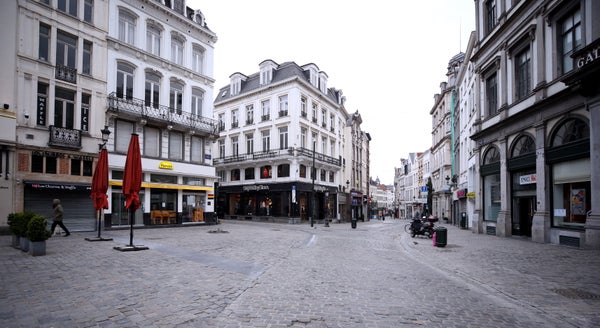
The coronavirus pandemic has brought chaos to lives and economies around the world. But efforts to curb the spread of the virus might mean that the planet itself is moving a little less. Researchers who study Earth’s movement are reporting a drop in seismic noise—the hum of vibrations in the planet’s crust—that could be the result of transport networks and other human activities being shut down. They say this could allow detectors to spot smaller earthquakes and boost efforts to monitor volcanic activity and other seismic events.
A noise reduction of this magnitude is usually only experienced briefly around Christmas, says Thomas Lecocq, a seismologist the Royal Observatory of Belgium in Brussels, where the drop has been observed.
Just as natural events such as earthquakes cause Earth’s crust to move, so do vibrations caused by moving vehicles and industrial machinery. And although the effects from individual sources might be small, together they produce background noise, which reduces seismologists’ ability to detect other signals occurring at the same frequency.
On supporting science journalism
If you're enjoying this article, consider supporting our award-winning journalism by subscribing. By purchasing a subscription you are helping to ensure the future of impactful stories about the discoveries and ideas shaping our world today.
Data from a seismometer at the observatory show that measures to curb the spread of COVID-19 in Brussels caused human-induced seismic noise to fall by about one-third, says Lecocq. The measures included closing schools, restaurants and other public venues from 14 March, and banning all non-essential travel from 18 March.
The current drop has boosted the sensitivity of the observatory’s equipment, improving its ability to detect waves in the same high frequency range as the noise. The facility’s surface seismometer is now almost as sensitive to small quakes and quarry blasts as a counterpart detector buried in a 100-metre borehole, he adds. “This is really getting quiet now in Belgium.”
Information boost
If lockdowns continue in the coming months, city-based detectors around the world might be better than usual at detecting the locations of earthquake aftershocks, says Andy Frassetto, a seismologist at the Incorporated Research Institutions for Seismology in Washington DC. “You’ll get a signal with less noise on top, allowing you to squeeze a little more information out of those events,” he says.
The fall in noise could also benefit seismologists who use naturally occurring background vibrations, such as those from crashing ocean waves, to probe Earth’s crust. Because volcanic activity and changing water tables affect how fast these natural waves travel, scientists can study these events by monitoring how long it takes a wave to reach a given detector. A fall in human-induced noise could boost the sensitivity of detectors to natural waves at similar frequencies, says Lecocq, whose team plans to begin testing this. “There’s a big chance indeed it could lead to better measurements,” he says.
Belgian seismologists are not the only ones to notice the effects of lockdown. Celeste Labedz, a graduate student in geophysics at the California Institute of Technology in Pasadena, tweeted that a similar fall in noise had been picked up by a station in Los Angeles. “The drop is seriously wild,” she said.
However, not all seismic monitoring stations will see an effect as pronounced as the one observed in Brussels, says Emily Wolin, a geologist at the US Geological Survey in Albuquerque, New Mexico. Many stations are purposefully located in remote areas or deep boreholes to avoid human noise. These should see a smaller decrease, or no change at all, in the level of high-frequency noise they record, she says.
This article is reproduced with permission and was first published on March 31 2020.
Read more about the coronavirus outbreak here.