
The items below are highlights from the free newsletter, “Smart, useful, science stuff about COVID-19.” To receive newsletter issues daily in your inbox, sign up here.
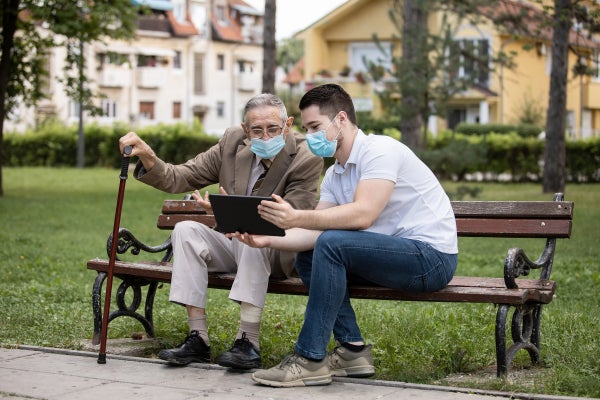
Grassroots volunteer efforts are “springing up” across the U.S. to help older adults navigate the confusing web sites for making COVID-19 vaccine appointments, reports freelance science writer Marla Broadfoot for Scientific American (3/3/21). Organized efforts are helping people in California, Kentucky and Maryland, some of which are bilingual in Spanish and in English, the story states. Some have a presence on social media, for which the story provides links.
Dr. Anthony Fauci, director of the U.S. National Institute of Allergy and Infectious Diseases, says that the U.S. will continue to adhere to a “two-dose strategy,” which large-scale human studies of the two-dose Pfizer/BioNTech and Moderna vaccines find to be highly effective in protecting people from severe cases of COVID-19, reports Dan Diamond at The Washington Post 3/1/21). A handful of relatively small studies, some of which have not been reviewed by outside experts for flaws, suggest that one dose of these vaccines might be protective enough people who recover from COVID-19. The UK has adopted a one-dose strategy to reach more people quickly with a reduced level of protection. Fauci says he understands the UK decision, but it “wouldn’t make sense in America,” he thinks, according to Diamond’s story. And Fauci warned that shifting to a single-dose of either of the two-dose vaccines “could leave people less protected, enable variants to spread and possibly boost skepticism among Americans already hesitant to get the shots,” Diamond writes.
On supporting science journalism
If you're enjoying this article, consider supporting our award-winning journalism by subscribing. By purchasing a subscription you are helping to ensure the future of impactful stories about the discoveries and ideas shaping our world today.
A 2/27/21 post by by Your Local Epidemiologist's Katelyn Jetelina, at University of Texas Health Science Center, counters misinformation that apparently went viral on what does and does not change for you after COVID-19 vaccination (2/27/21). The post ends with a quick summary: “The COVID-19 vaccine…does give immunity, does eliminate the virus, does prevent death, does not guarantee you won’t get it” (but if you do, “it will certainly be more mild”). The vaccine “does stop you from passing it on (about 70 percent of the time), does eliminate the need for travel bans (eventually), does eliminate the need for business closures (eventually)…does eliminate the need for masking (eventually).”
For more nuance on this post-vaccination subject, check out Rachel Gutman’s 2/25/21 piece at The Atlantic, which basically says you can loosen up a little, but play it safe and don’t rush back to restaurants, bars and large gatherings. The story states that epidemiologist Saskia Popescu of George Mason University advises people to keep track of the number of new daily cases per 100,000 people in their area and the local positivity rate (rate at which people test positive for the virus), among other statistics. Look for just one or two new daily cases per 100,000 people and for positivity rates at or below 2 percent, the story suggests. “Plenty of public-health experts have argued that vaccinated people safely seeing relatives or returning to the office can benefit everyone” for its persuasive effect on the non-vaccinated, the story states. But vaccinated people should make sure not to take risks that put unvaccinated people in danger. Grandparents can hug their grandchildren but ask to wear masks during hugs, to meet outdoors, or to avoid sleeping over, the story suggests. “A vaccinated oncologist who lives with her immunocompromised sister is going to behave differently from a vaccinated retiree who lives alone,” the story states.
Here’s a highly accessible, updated guide to face masks, by Tara Parker-Pope at The New York Times (2/24/21). It is laid out as a slide show with brief captions.
I like this accessible, engaging video illustrating the concept of herd immunity and how it could play out in the COVID-19 pandemic, by Oregon Public Radio (2/24/21). Thanks to a reader for suggesting this piece.
You might enjoy “Okay, let me just share my screen…Ah, nope. Okay, you’re looking at my savings account now. That is not good,” by Austin Adams for McSweeney’s (3/4/21).