
The items below are highlights from the free newsletter, “Smart, useful, science stuff about COVID-19.” To receive newsletter issues daily in your inbox, sign-up here. Please consider a monthly contribution to support this newsletter.
Atmospheric chemist Jose L. Jimenez at the University of Colorado-Boulder has created a fairly simple, downloadable spreadsheet tool that allows you to estimate the risk of airborne SARS-CoV-2 infection in various spaces — including a classroom, campus, subway, bus, demonstration, and outdoors. Jimenez tweeted on 6/23/20 that the tool is based on a simplified model that makes the “best scientific estimate” of airborne transmission under various conditions. Virginia Tech aerosol scientist Linsey Marr, listed as contributing to the tool tweeted that the model behind the tool assumes that air is well-mixed and that people observe physical distancing (thus, droplet transmission would not occur). Here’s how Jimenez says to use the tool: go to the url below, select “file" and then "download” in the Google-Spreadsheets file menu at the top of the page; choose to download the file as an .xls file; click on the downloaded file and it will open in MS Excel; change inputs in the yellow cells to new values; the blue cells automatically re-calculate the two types of risk. The spreadsheet can be adapted to other cases for which inputs are known, Jimenez says. I still have to measure my classroom dimensions but based on other known quantities, the tool estimates that each of my students has a 12 percent chance of infection if another student or I has the virus and that I have a 1.5 percent risk of infection if one of the students is infected.
STAT has updated its COVID-19 Tracker site, according to a 6/23/20 email to STAT newsletter subscribers from the publication's executive editor. The update enables insights into “the rolling average of new cases” over periods of time such as 1 day, 3 days, 5 days, 1 week, 1 month etc. And it enables views of the “rate of infection and of deaths per 100,000 people” by region, writes Richard L. Berke.
On supporting science journalism
If you're enjoying this article, consider supporting our award-winning journalism by subscribing. By purchasing a subscription you are helping to ensure the future of impactful stories about the discoveries and ideas shaping our world today.
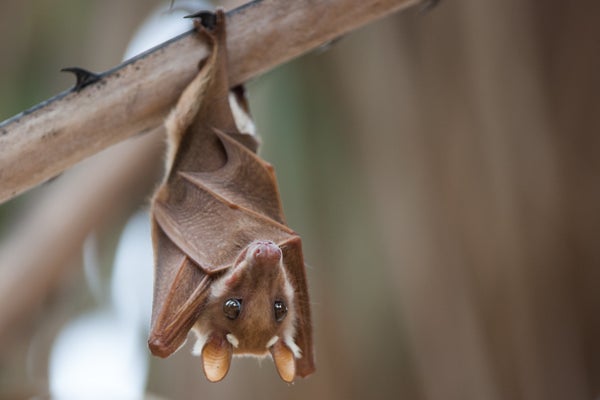
Bats host all kinds of viruses, including many that are deadly in people, such as the Nipah and Marburg viruses, as well as some that are “very close relatives of the ones that caused the 2003 SARS outbreak and today’s COVID-19 pandemic,” writes Rachel Ehrenberg at Knowable (6/19/20). Yet with a few exceptions, the viruses don’t make bats sick. The key to that success may lie in special features of the bat immune system, ones that spark responses to viral invasion that differ from what goes on in people, Ehrenberg’s excellent story explains. Bats’ biology seems to have a "keep calm and carry on” approach in which the immune system limits collateral damage to the host but doesn’t get rid of every trace of a pathogen, she writes. Especially important is bats' ability to limit inflammation — out-of-control inflammation is a common theme in severe illnesses from viruses that have jumped from other species, including Ebola, some strains of influenza, and SARS; and it's often what kills people with severe cases of COVID-19, she writes. Ehrenberg's story describes scientists’ efforts to "better understand how bats tolerate viral passengers" — bats’ biology might step up activity of one immune molecule, say, or dial down activity of another — and thus "how viral infections proceed in people. That, in turn, might eventually point to treatments that could make infections in people less severe," she writes.
Epidemiologist Michael Osterholm, director of the Center for Infectious Disease Research and Policy (CIDRAP) at the University of Minnesota, says in this 6/17/20 NPR interview that a significant drop in cases this summer is not necessarily good news. “I don’t want anybody to get sick, severely ill, or die. But if we saw a trough of cases in the next two months, I think that would really tell us that we’re likely to have this big second wave.” To date, about 5 to 7 percent of the U.S. is infected with SARS-CoV-2, he says. The virus, he adds, will “keep transmitting until we get at least 60 or 70 percent of the population infected and hopefully develop immunity — or if we get a vaccine, that can get us there too.” Osterholm also emphasizes that hand washing remains important but that “we’ve gone way overboard relative to the disinfection” of surfaces such as postal mail. He says that he doesn’t worry about food, newsprint, packages, doorknobs or railings any more than he would during a regular cold season. “This is really all about air. Breathing some else’s air where the virus is present,” he says in the interview.
Adrienne So at Wired has written a piece, “15 face masks we actually like to wear,” about cloth face coverings that Wired employees reportedly like for "running, walking, and going to work” (6/25/20).
Play this page’s YouTube video, produced by Eugenio Ampudia as part of the “Concert for the Biocene” at Barcelona’s Gran Teatre del Liceu. The theater re-opened on 6/22/20, and the video features the UceLi Quartet playing Puccini’s “Crisantemi” for a live audience of plants, NPR reports.
Read more about the coronavirus outbreak from Scientific American here. And read coverage from our international network of magazines here.