
The items below are highlights from the free newsletter, “Smart, useful, science stuff about COVID-19.” To receive newsletter issues daily in your inbox, sign up here
.
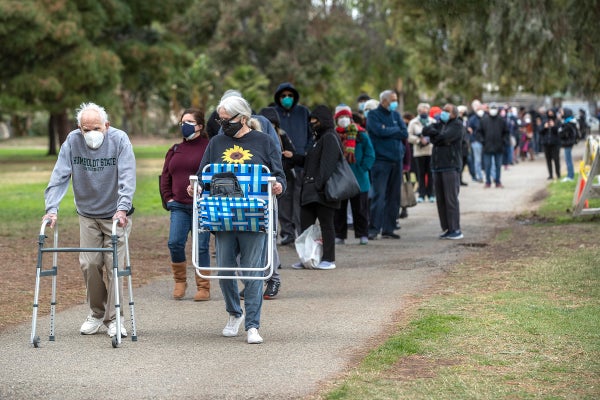
A question-and-answer piece with Dr. Leana Wen of the George Washington University School of Public Health explains why COVID-19 vaccination in the U.S. is going so slowly and “the need to balance speed with fairness" (1/26/21), as freelance science writer Marla Broadfoot writes for Scientific American. The priority tiers developed by the U.S. Centers for Disease Control look good on paper but are rigid, Wen states in the piece. “At this point, the necessary step is to relax the measures and open vaccination up to broader categories of eligibility because there has been a lack of infrastructure to implement this the right way,” she states. A first-come, first-served policy will reach more people and avoid wasted doses, but disadvantage people with limited cell phone minutes, or weak or absent Internet service, as well as people who are less tech savvy. But this is a “race against time,” Wen says, and delaying progress toward herd immunity gives the virus more time to mutate to strains that are potentially more contagious or cause more severe disease or elude the available vaccines.
On supporting science journalism
If you're enjoying this article, consider supporting our award-winning journalism by subscribing. By purchasing a subscription you are helping to ensure the future of impactful stories about the discoveries and ideas shaping our world today.
Some useful items in Helen Branswell’s 1/25/21 “COVID-19 vaccine basics” piece for STAT include: 1) large-sample experimental results on the effectiveness and safety of Johnson & Johnson’s one-dose, “fridge-stable” vaccine are expected this week or next, which could lead to emergency-use authorization by the U.S. Food and Drug Administration in mid-February, according to Operation Warp Speed’s co-chair; 2) If all goes well, significant numbers of J&J vaccine doses would be available in the U.S. starting in April, same source says, in the story; 3) AstraZeneca’s vaccine could be submitted and authorized for use on an emergency basis in the U.S. in March; 4) Novavax’s vaccine — potentially late March/early April for submission and authorization in U.S.; and 5) click this link to start finding out when and where to get vaccinated in your state.
There’s plenty of Real Talk about the U.S. COVID-19 vaccine supply in this 1/21/21 piece by Katie Thomas at The New York Times. For instance, “there are simply not enough doses of authorized vaccines to meet the enormous demand. And that is not likely to change for the next few months,” she writes. Facilities that make the vaccines are already “at or near capacity,” the story states, so using the Defense Production Act will not increase supply much. It is unlikely that states will be able to buy vaccines directly from manufacturers, Thomas reports. In good news, “Pfizer and Moderna say their factories are ramping up and expanding capacity each week,” Thomas writes. Even if no other vaccines are authorized or approved in the U.S., a conservative estimate is that “there could be enough vaccines” for everyone in the U.S. “by the summer,” the story states.
A 1/26/21 essay in The New York Times puts to rest some circulating myths and false rumors about fertility and COVID-19 vaccines. It’s true that early experiments (trials) on the Pfizer/BioNTech and Moderna vaccines did not include pregnant and lactating women, but “neither mother nor infant is at any risk for coronavirus infection from the vaccines,” write Alice Lü-Culligan, a dual medical/doctoral student, and immunologist Akiko Iwasaki, both at at Yale School of Medicine. Studies of COVID-19 vaccines in animals have shown no effects on pregnancy, the essay states, and human studies are “in the works.” Other vaccines that are “routinely and safely administered to pregnant women” include flu shots, tetanus shots, and those that protect against diphtheria and pertussis, the essay states. “For any woman who is pregnant, nursing or trying to conceive, contracting COVID-19 is almost certainly more dangerous than getting immunized,” Lü-Culligan and Iwasaki write.
You might enjoy, “The art of conversation for eloquent sophisticates,” by Sean McGowan, for McSweeney’s (1/28/21).