Cosmic-Level Anxiety

Scientific American Space & Physics, February/March 2022

Scientific American Space & Physics, February/March 2022

Join Our Community of Science Lovers!


On supporting science journalism

If you're enjoying this article, consider supporting our award-winning journalism by subscribing. By purchasing a subscription you are helping to ensure the future of impactful stories about the discoveries and ideas shaping our world today.


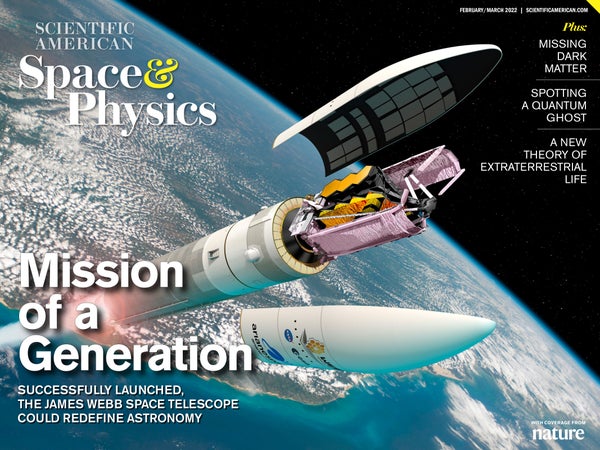
On this past Christmas Day, NASA scientists and engineers cheered and breathed a cautious sigh of relief for the first time in, likely, years. The James Webb Space Telescope launch had gone off successfully, after years of delay, budget overages and technical challenges. In the ensuing weeks, the anxiety has kept up a steady hum while the telescope performed crucial early mission tasks to get itself situated to start collecting data—namely, unfurling its sunshield and mirrors. Read Alexandra Witze’s update outlining these accomplishments. The telescope’s operators are far from relaxing, but each mission milestone marks the start of a new era of astronomy, as Richard Panek reports in this issue (see “The James Webb Space Telescope Has Launched: Now Comes the Hard Part”).

NASA has another exciting mission underway: the Double Asteroid Redirection Test (DART). Designed as part of our planetary defense plan (see “NASA’s DART Mission Could Help Cancel an Asteroid Apocalypse”), a test spacecraft launched at the end of last November and will smash into its target sometime in the fall of 2023. I anticipate many months of thrilling anxiety for NASA scientists. If all goes well, the payoffs will be cosmic.

Andrea Gawrylewski is chief newsletter editor at Scientific American. She writes the daily Today in Science newsletter and oversees all other newsletters at the magazine. In addition, she manages all special editions and in the past was the editor for Scientific American Mind, Scientific American Space & Physics and Scientific American Health & Medicine. Gawrylewski got her start in journalism at the Scientist magazine, where she was a features writer and editor for "hot" research papers in the life sciences. She spent more than six years in educational publishing, editing books for higher education in biology, environmental science and nutrition. She holds a master's degree in earth science and a master's degree in journalism, both from Columbia University, home of the Pulitzer Prize.

More by Andrea Gawrylewski
SA Space & Physics Vol 5 Issue 1This article was published with the title “Cosmic-Level Anxiety” in SA Space & Physics Vol. 5 No. 1 ()
doi:10.1038/scientificamerican022022-3Xr5ZyAOUJh63pfpiZMD3M

It’s Time to Stand Up for Science

If you enjoyed this article, I’d like to ask for your support. Scientific American has served as an advocate for science and industry for 180 years, and right now may be the most critical moment in that two-century history.

I’ve been a Scientific American subscriber since I was 12 years old, and it helped shape the way I look at the world. SciAm always educates and delights me, and inspires a sense of awe for our vast, beautiful universe. I hope it does that for you, too.

If you subscribe to Scientific American, you help ensure that our coverage is centered on meaningful research and discovery; that we have the resources to report on the decisions that threaten labs across the U.S.; and that we support both budding and working scientists at a time when the value of science itself too often goes unrecognized.

In return, you get essential news, captivating podcasts, brilliant infographics, can't-miss newsletters, must-watch videos, challenging games, and the science world's best writing and reporting. You can even gift someone a subscription.

There has never been a more important time for us to stand up and show why science matters. I hope you’ll support us in that mission.

Thank you,

David M. Ewalt, Editor in Chief, Scientific American

Subscribe