
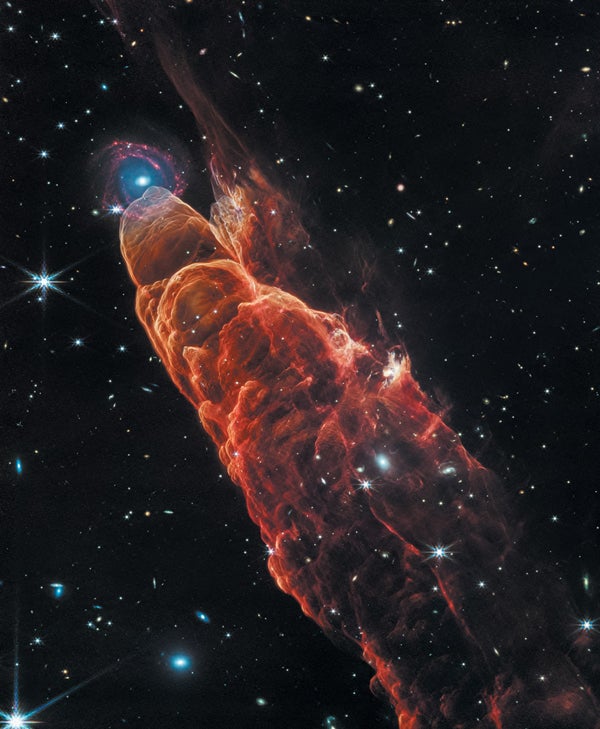
When a star is born, the process leaves behind a flurry of high-energy gas, dust and debris. Some of this remnant material clumps together into planets, the way Earth likely formed. Others end up floating endlessly as meteors and space dust. But when conditions are just right, powerful plasma jets blasting out of a young star whip some of the debris into a giant, helical tower of steamy-looking cosmic dust—one of which we now can see better than ever before, thanks to the James Webb Space Telescope (JWST).
Astronomers had long been aware of these so-called Herbig-Haro objects—brilliant flares of ionized gas, often near newborn stars, that can be light-years long—including one named HH 49/50, whose characteristic shape led to its nickname of “cosmic tornado.” This object shines in the Chamaeleon I Cloud complex 625 light-years from Earth. Back in 2006, when HH 49/50 was first spotted by the now decommissioned Spitzer Space Telescope, astronomers could make out only an out-of-focus (albeit recognizably helical) lump of heated gas and dust with something shining at its tip. Although it was an exciting discovery at the time, the image’s low resolution left the situation blurry.
Now, with the much bigger JWST, the full picture snaps into focus: the telescope captured this field of dust and debris just as a baby protostar (probably located somewhere on its lower right, outside the boundary of the image shown here) was blasting it into this very particular shape. The fuzzy blob at the top resolves into a distant spiral galaxy unrelated to the object itself. Its apparent position atop this ongoing event is just a quirk of our perspective.
On supporting science journalism
If you're enjoying this article, consider supporting our award-winning journalism by subscribing. By purchasing a subscription you are helping to ensure the future of impactful stories about the discoveries and ideas shaping our world today.
This view, and the great distance, also creates a few other optical illusions, says Macarena Garcia Marin, an astrophysicist at the European Space Agency who was part of the team that took the new image. For example, the smaller dots appearing to float in front of the cosmic tornado aren’t dust; they’re actually entire galaxies shining through from behind it. The pointy dots are lone stars.
Still, the chance alignment of these cosmic entities lets scientists study a rich array of extraterrestrial phenomena, says Melissa McClure, an astronomer at Leiden University in the Netherlands who was not on the imaging team. Notably, we can see processes such as accretion in action, she says—“And the image is just gorgeous!”
Garcia Marin is particularly struck by the JWST picture’s ephemeral nature, at least on cosmic scales. When the protostar eventually grows up, most likely beyond our lifetimes, the jets it produces and the accompanying cosmic tornado will fade, Garcia Marin says: “You’re looking at a snapshot of a moment in the universe.”