
On supporting science journalism
If you're enjoying this article, consider supporting our award-winning journalism by subscribing. By purchasing a subscription you are helping to ensure the future of impactful stories about the discoveries and ideas shaping our world today.
Astronomy buffs know that the European Southern Observatory (ESO), a conglomerate of 15 European countries that operates three observing sites in Chile, is a font of awesome space images. What they may not know is that some of the ESO's best images are buried in its extensive data archives. Terabytes of raw data gathered by the observatory's world-class instruments dwell in its digital vaults, waiting for image-processing experts to pluck them from anonymity and transform them into gorgeous, full-color pictures.
Last fall, the ESO decided to crowd-source the job, calling it the Hidden Treasures competition. Amateur enthusiasts were to select data from the archives and process their own stunning, scientifically accurate images.
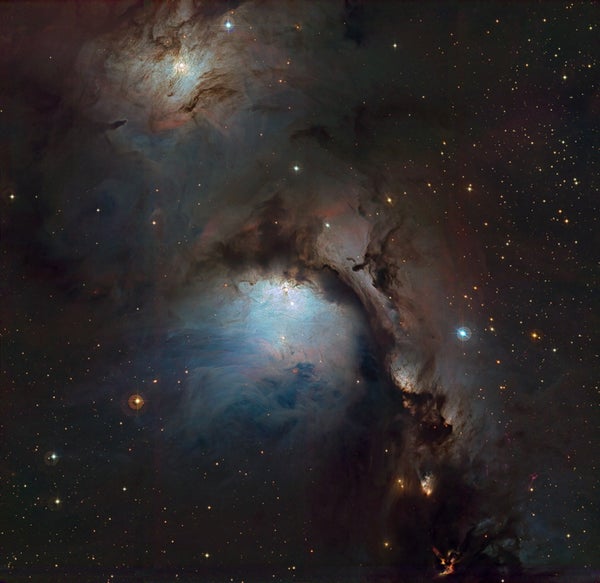
This image of the nebula Messier 78, submitted by Igor Chekalin of Taganrog, Russia, took first place in the competition. "It was a great experience. I mean not only winning, but working with perfect raw data from large professional instruments with modern high-resolution mosaic CCD [charge-coupled device] cameras," says Chekalin, a programmer and IT specialist by day.
Messier 78 is a reflection nebula in the Orion constellation. Essentially, it is a cloud of interstellar dust illuminated by two nearby stars, HD 38563A and HD 38563B. Reflection nebulae often appear blue because the tiny dust particles scatter blue light more efficiently than they scatter red light.
A major challenge of the competition, Chekalin says, was finding the right data sets, because "professional image-acquisition tactics, unlike the amateur photographer's way, are not always aimed at making spectacular, colorful pictures." After stumbling on the Messier 78 data by chance—"It was pure luck to find it, and it was the first good object that I found," he says—Chekalin wrote computer scripts that automatically screened for certain parameters to help him dig out promising data sets. He taught himself how to use the sophisticated processing software and spent a week's worth of evenings perfecting the final winning image. Two of his other submissions also placed in the top 10.
After the Hidden Treasures winners were announced in January, the ESO's in-house image experts decided to try their own hands at Messier 78. Chekalin judges the ESO's version, released February 16, to be "technically perfect," although aesthetically, he prefers his own work.
—Nina Bai